
Projects here run from a $420 red Dutch oven on the stove to full walnut cabinets at $200–$350 per linear foot, and whether you can change your cabinets decides where you start.
Owners can skip the high end by putting walnut or teak veneer doors on existing boxes for $70–$120 per linear foot.
1. Warm Wood and Woodgrain
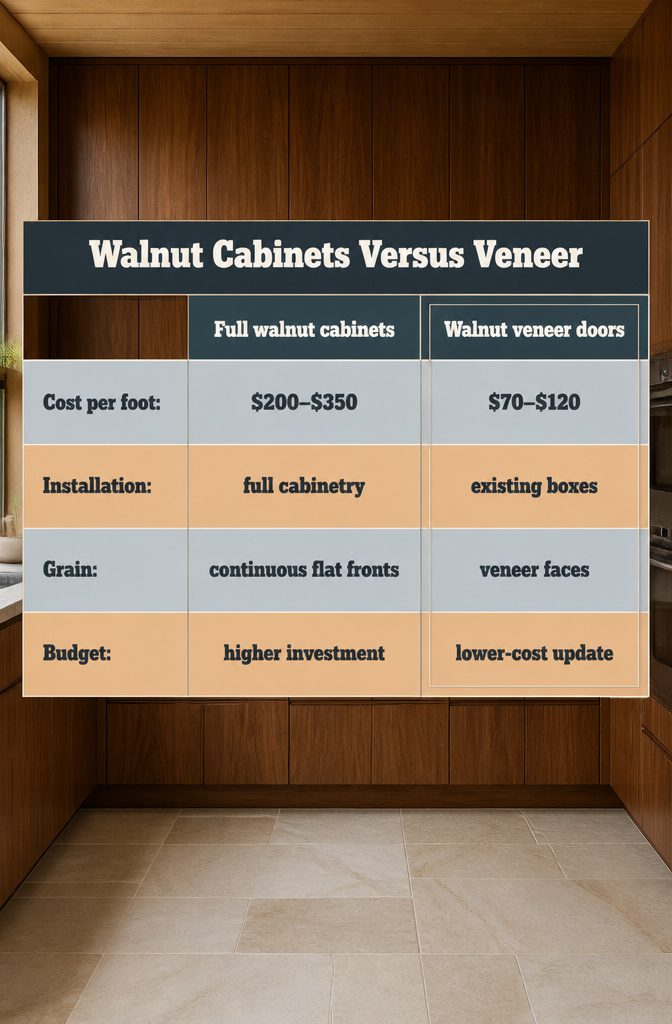
Walnut is the species most tied to the era, and flat-front doors let its grain run unbroken across the kitchen.
Teak, rosewood, oak, elm, sapele and chestnut all suit the look too. Full walnut cabinets run about $200–$350 per linear foot, so the budget route is new flat-panel walnut or teak veneer doors on your existing boxes, at $70–$120 per linear foot.
Pick a light, natural wood to keep the room from feeling heavy.
For a warmer, truer mid-century feel, choose a darker, orange-toned stain, which keeps the kitchen from reading muted and Scandinavian. Paneling or a wood ceiling adds grain where cabinets can’t.
2. Bold or Contrasting Color
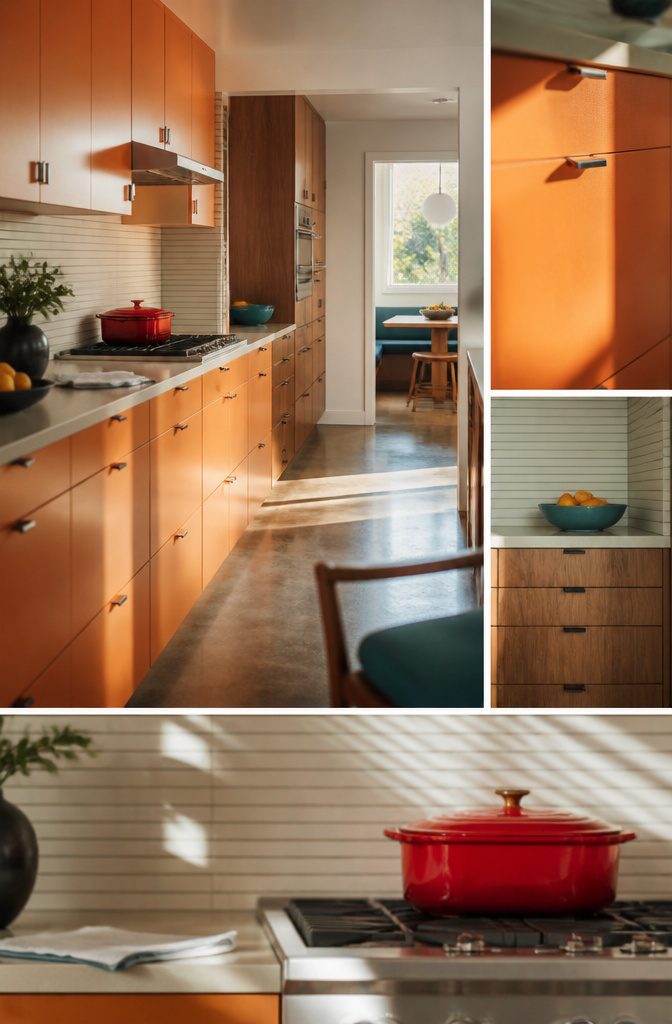
Color-blocked cabinets are the boldest move here. Painted wood cabinets in sun and citrus shades, paired with SMEG appliances in hues matched to them, make the whole run read as one plan.
This style prefers matching colors over clashing ones, so keep the loud shades in one family.
Strong color needs a quiet partner.
Walnut cabinetry carries orange, teal, or chartreuse without a fight. Use cream, black, or white for everything else, and choose white walls if your kitchen is small, since they open it up.
If you rent or aren’t ready to paint, a red enameled cast iron Dutch oven ($420) on the stove gives you one saturated accent with no commitment.
3. Muted, Earthy Palettes
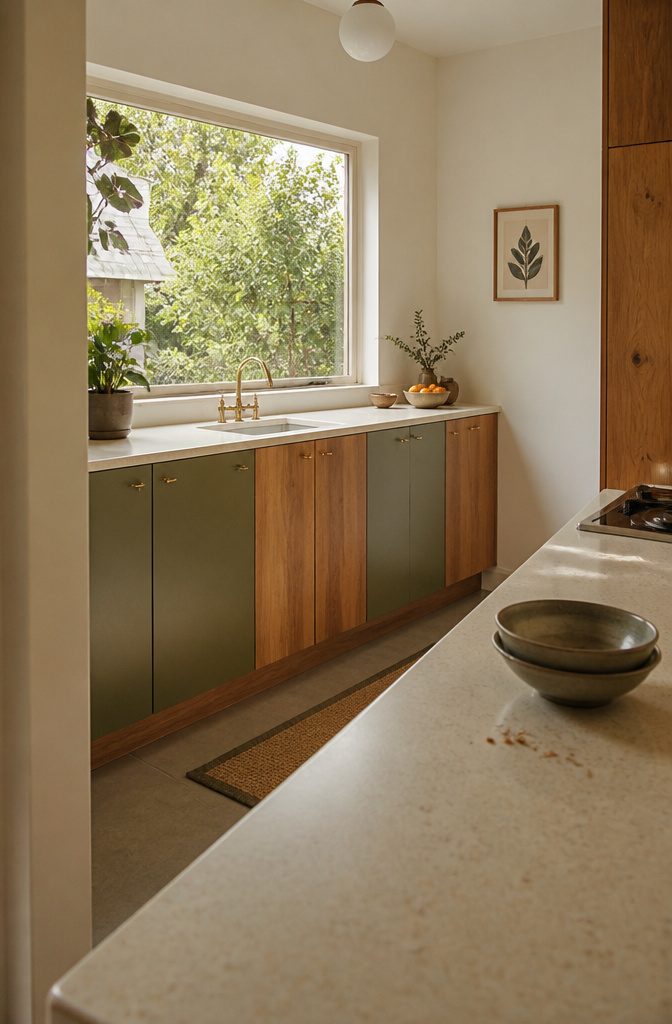
Mid century color doesn’t have to mean orange and turquoise.
Buttery yellow, mint green, soft blue, rich browns and clay reds are all period-appropriate. They suit renters and anyone wary of loud color, since a soft palette is easy to live with and easy to build on.
Wood is where these tones work best.
Muted green cabinet fronts next to warm wood look retro without shouting. Cream and gray balance the darker browns, and white walls help a small kitchen feel bigger.
For a budget surface, Make it Mid Century’s SparkleLam laminate comes in 15 colors, with gold or silver flecks. Choose a quiet shade, and the sparkle adds period character without taking over the room.
4. Geometric Tile and Pattern
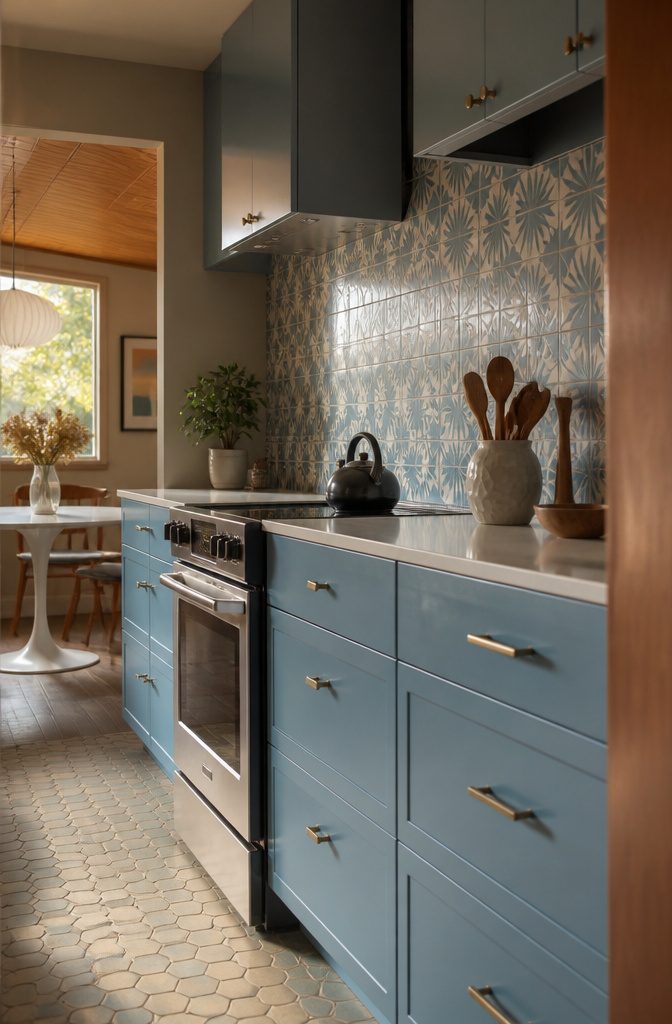
Backsplash tile is the cheapest way to bring graphic shapes into a mid-century kitchen.
It runs $6–$10 per square foot, and Fireclay Tiles counts it among the most affordable retro updates. A backsplash covers only a few feet of wall, so even a bold pattern stays inexpensive.
Hexagons, diamonds, and starburst designs read as mid-century at once. Elongated subway tile is the quieter option.
A hand-glazed mosaic or hand-painted ceramics suit a single wall behind the range. Starburst tile looks especially good against soft blue cabinets with brass pulls.
On the floor, honeycomb tile works best in muted colors, so the shape carries the look and the palette stays calm.
5. Terrazzo Surfaces
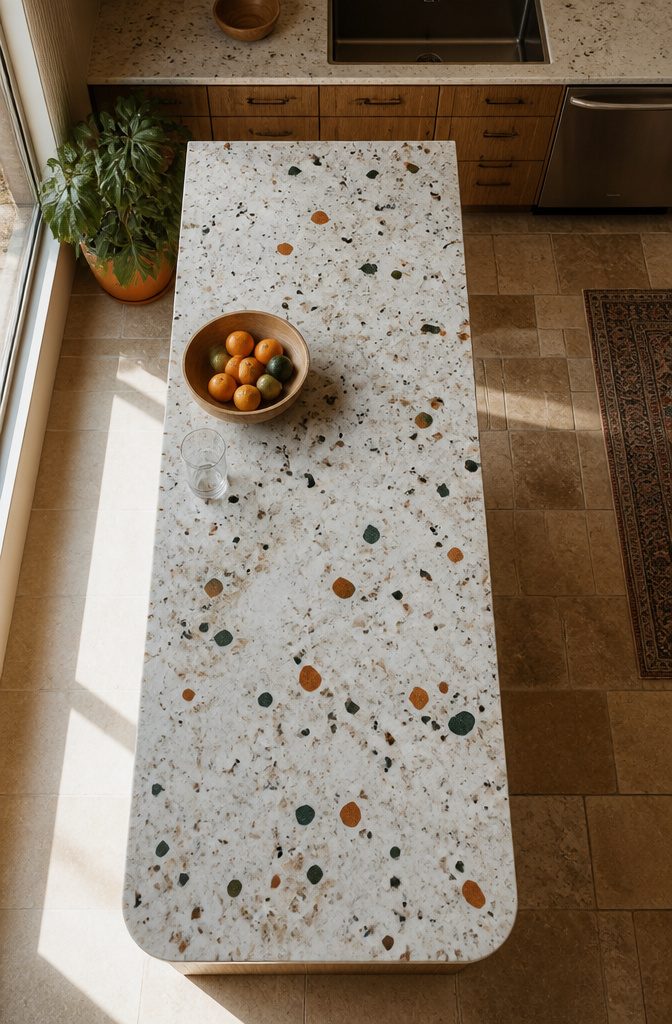
Terrazzo is stone chips, often marble, set in cement. It appeared in the 1920s and reached everyday homes in the mid-century, so it reads as period-correct on counters, backsplashes, and floors.
The flecks supply pattern without requiring a loud color. A cool white base scattered with emerald and orange marble chips gives a counter plenty of energy, yet the surface still looks like one solid block of stone.
Chips come in nearly any color combination, so you can keep the base neutral or pick a fleck that echoes your cabinets.
A backsplash is where terrazzo adds a color pop. On the floor it is hardwearing enough for a family kitchen, and it looks warmer next to wood.
6. Distinctive Shapes, Clean Lines
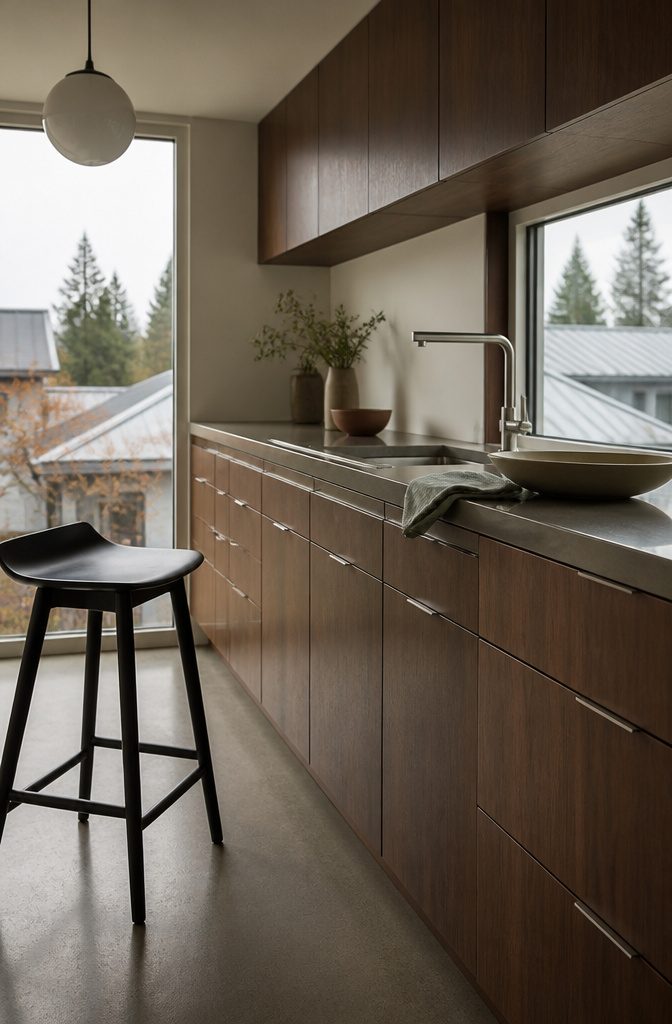
Flat-front cabinets set the baseline: slab doors with no raised panel and minimal hardware keep the straight lines this style depends on. Then add a few deliberate curves, which worked in the 1950s when used with restraint.
Pair a curved pendant with a clean countertop, or rounded appliances with a sharp faucet. BLANCO’s angular LINUS faucet is a minimalist pick that comes in metal and full-color finishes.
For seating, chairs in the style of 1950s Paolo Buffa look good against walnut cabinetry.
The Aurora mid-century stools are an easy buy at $299.99, in black, brown or cream. Stop at a few curved pieces, or the lines stop reading as clean.
7. Lighting as a Feature
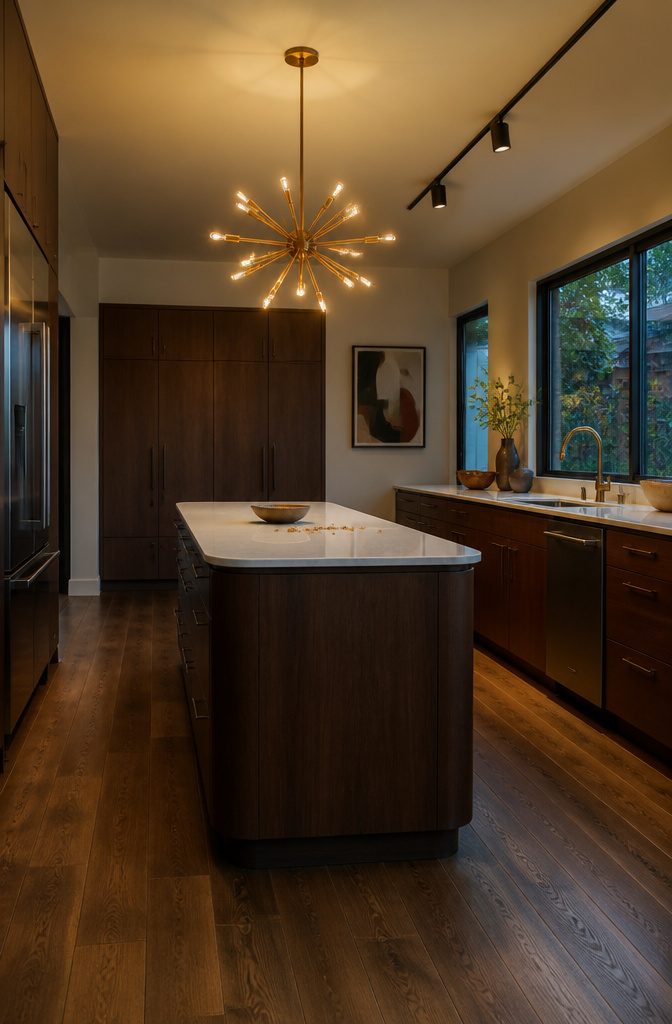
Globe pendants and small sputnik chandeliers both run $150–$200 each. A sputnik or brass starburst chandelier delivers the period look in a single fixture, while globes suit a row of small lights over an island or sink.
Choose one as the statement and keep everything else plain, so the fixtures don’t compete.
Track lighting works best in a long, narrow kitchen. It took off in the 1960s and 1970s, it pulls the eye along the ceiling, and you can angle each head toward the counter you use most.
A Charge LED track kit starts at $99.87 in white, black, brushed nickel, or dark bronze, which makes it the cheapest way into the look. Pick by what the light has to do and how it changes the room.
8. Open Shelving, Fewer Uppers
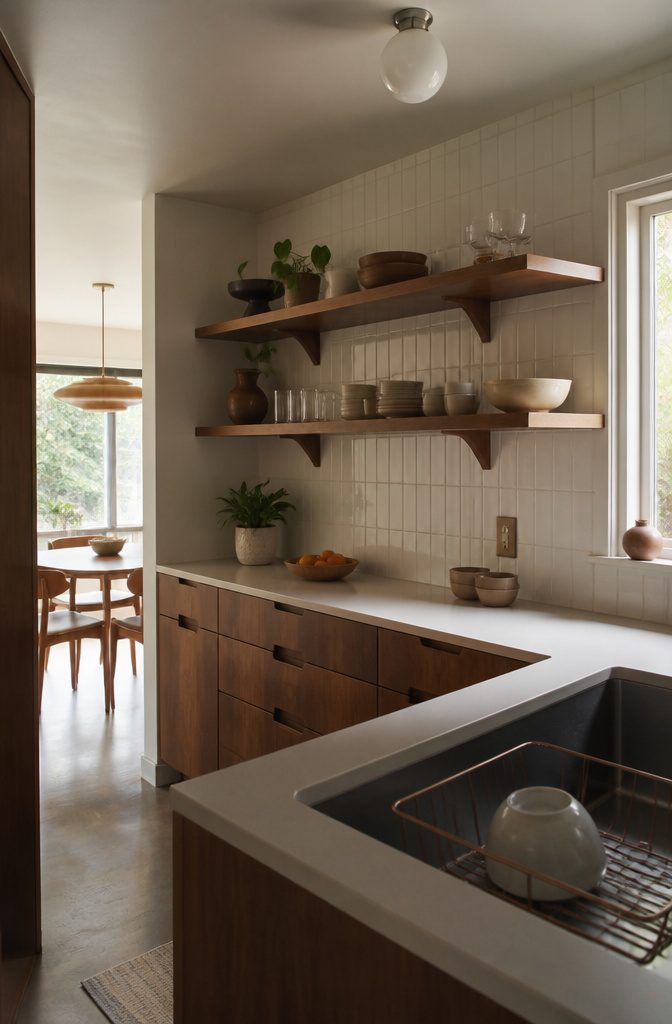
Skip the full tear-out and swap the upper cabinets on one wall. Mid-century kitchens often had none, and open shelves in their place hold glassware, ceramics and plants while the wall feels lighter.
Over the sink or at the end of a cabinet run is the easiest spot, and wood shelves stacked against a tiled backsplash suit the era.
The cost is that everything stays visible and collects dust. Put on display only what you’d happily leave out, and move mugs, mixing bowls and pots into deep lower cabinets or an island.
Over a weekend, you can remove the cabinet, patch and paint the wall, and hang the shelves with brackets screwed into studs.
9. Social Seating and Dining
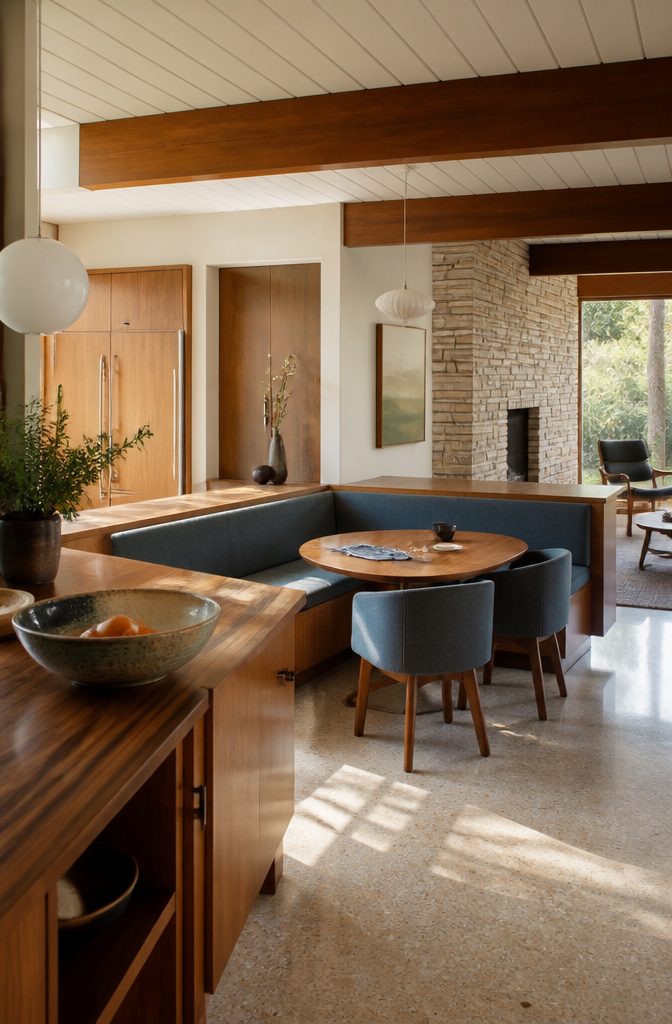
Eat-in kitchens replaced formal dining rooms in the ’50s and ’60s, so seating belongs in a mid-century kitchen from the start.
In a small space, a built-in corner bench at the end of the counter beats a freestanding table: guests sit beside the cook, and you skip the floor space chairs need on all sides.
A kitchen diner has room for a bean-shaped table with upholstered seats, which suits the era’s curves. At an island or peninsula, stools do the work.
A blue velvet seat with metal legs costs $359 and stands 35.83 inches tall (20.08 × 19.69 inches), so measure your counter against that height before ordering a set. Arne Jacobsen’s 1967 Dot Stool is the classic wood-kitchen pairing.
10. One Focal Point
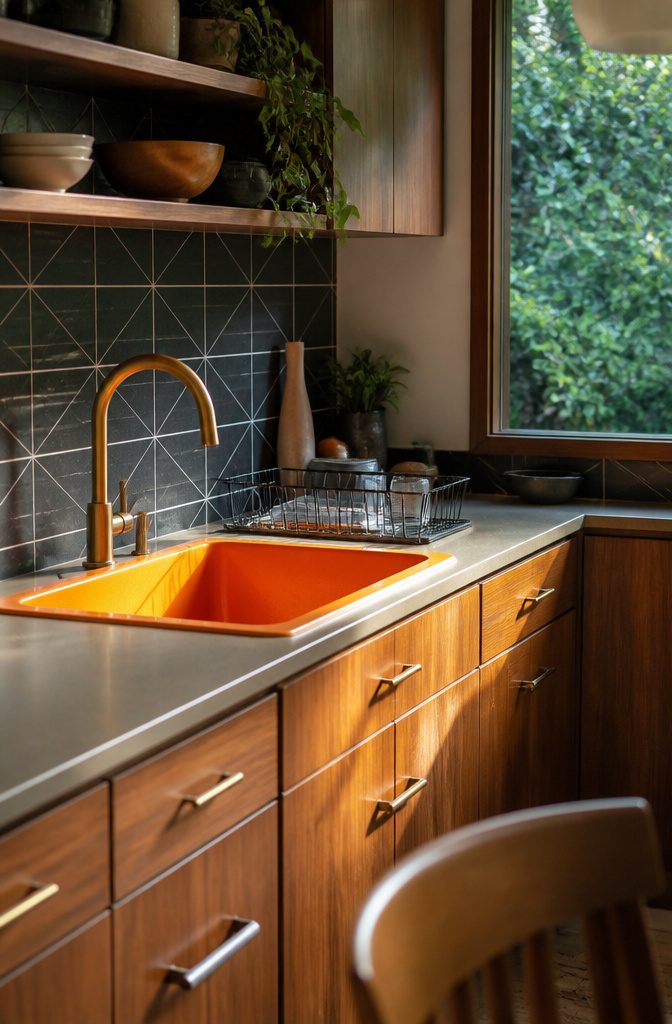
Pick one feature to lead, then build everything else around it. Strong candidates are an ornate pendant, a dramatic island, a bean-shaped dining table, or a vintage stove.
A vivid orange sink also works. Set against walnut cabinetry and a dark geometric tile backsplash, it becomes the first thing you see, while the wood, tile and metal accents stay in supporting roles.
To choose, start with what the room already gives you.
If the island is the largest object in the kitchen, let it lead and keep the pendant plain. If you can’t change the layout, make the lighting or a retro-colored fixture the star.
Whichever you pick, everything else should complement the statement, not rival it. Two loud pieces split attention, and the kitchen starts to look cluttered.
11. Metal Details and Cabinets
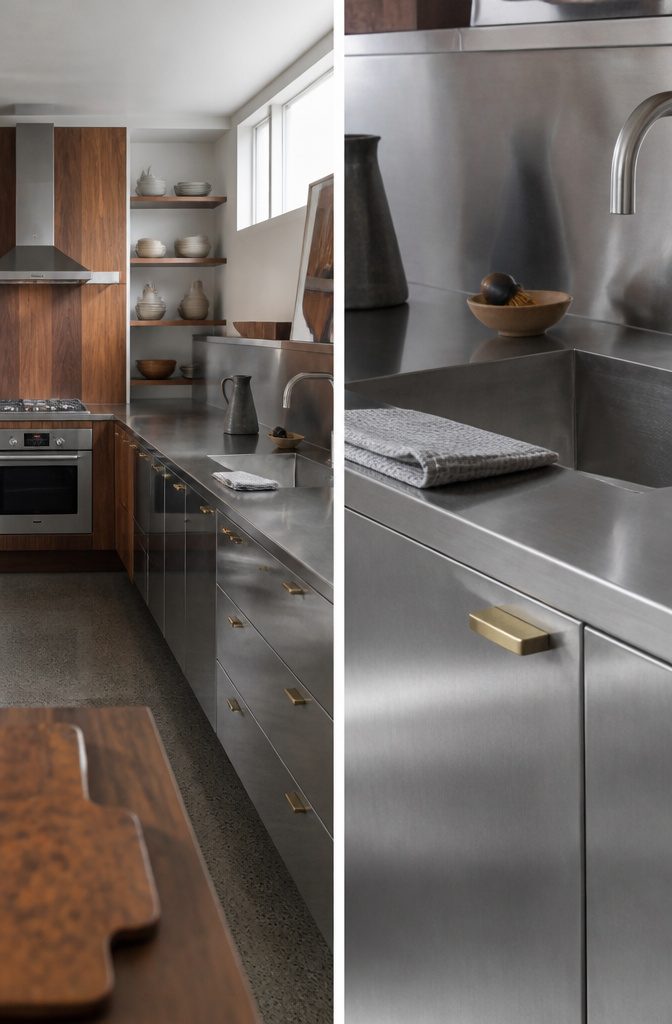
Warm metals work best in small amounts. Brass, gold or brushed nickel on cabinet handles adds a glint, and brass pulls look sharp on soft blue cabinets.
A brass piece measuring 18¾ × 2⅛ × 10¾ inches costs $299.95, so one or two metallic accents beat metal on every surface. A gold leg under a peninsula works the same way.
For a bigger statement, use stainless steel on cabinets, backsplashes or countertops. It reads sleek and modern, yet it was showing up in everyday homes by the 1920s, so it suits the period.
A stainless oven and hood set against wood looks planned rather than cold. Metal tower units for pots and plates add a futuristic touch.
12. Plants and Outdoor Views
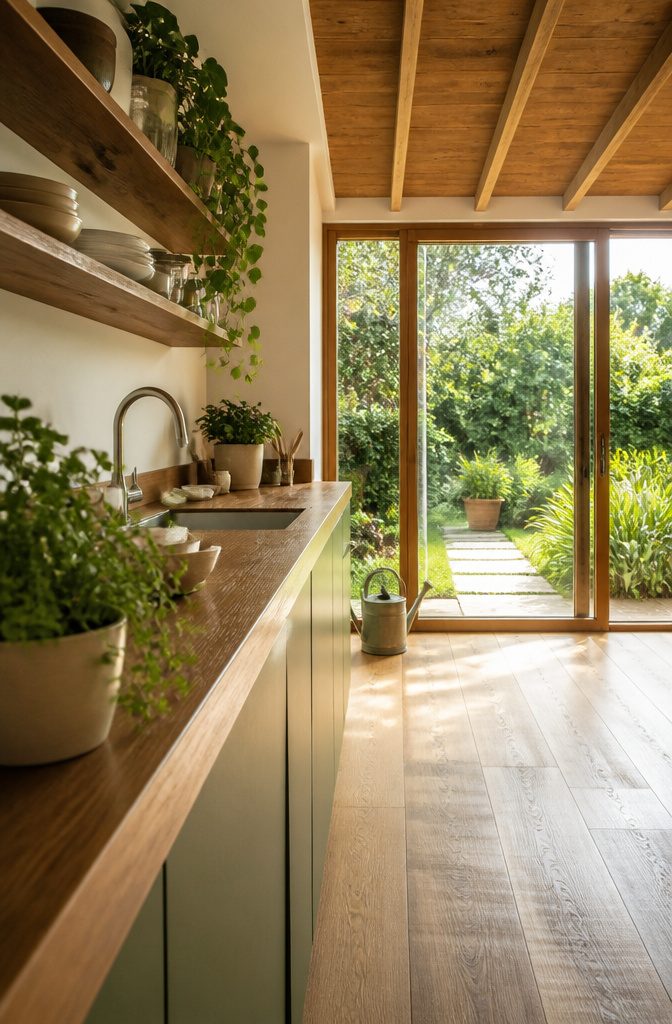
Mid-century kitchens treat the outdoors as part of the room, and glass does most of that work: large windows, French doors, or a skylight.
Wide glass doors under a natural wood ceiling make a warm, open kitchen that connects to the yard.
If you rent or can’t add either one, paint the walls white so the room feels airier and your existing windows go further.
Plants finish the idea. Set potted plants on the windowsill, or let trailing ivy spill from open cabinetry.
Wood shelving that holds dishes, ceramics, and plants together ties the greenery to the wood and earthy tones around it. Muted green cabinet fronts next to warm wood echo the leaves.
Layout and Flooring
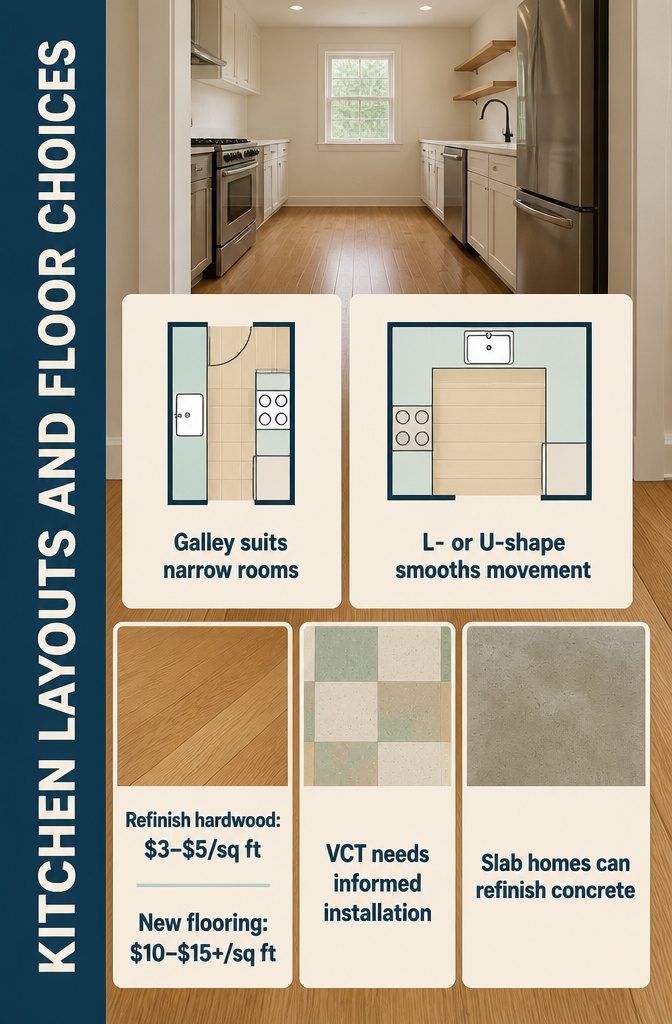
Match the layout to the room’s shape, then choose a floor based on what you already have.
- Galley: the best fit for a narrow room.
- L-shaped or U-shaped: these give smoother movement between cooking, prep and dining.
- Natural wood: if hardwood is already down, refinish it in a satin or semi-matte finish to show the grain. Refinishing runs $3–$5 per square foot, against $10–$15 or more for new installation.
- VCT: it is period-correct, but owners on Reddit say local contractors and flooring stores knew little about it, and one had to catch a wrong underlayment. The same owner found one VCT line far pricier than its "budget" reputation.
- Polished concrete: on a slab house, refinish the existing concrete. One Reddit owner plans a light stain.
Keep the Look Restrained
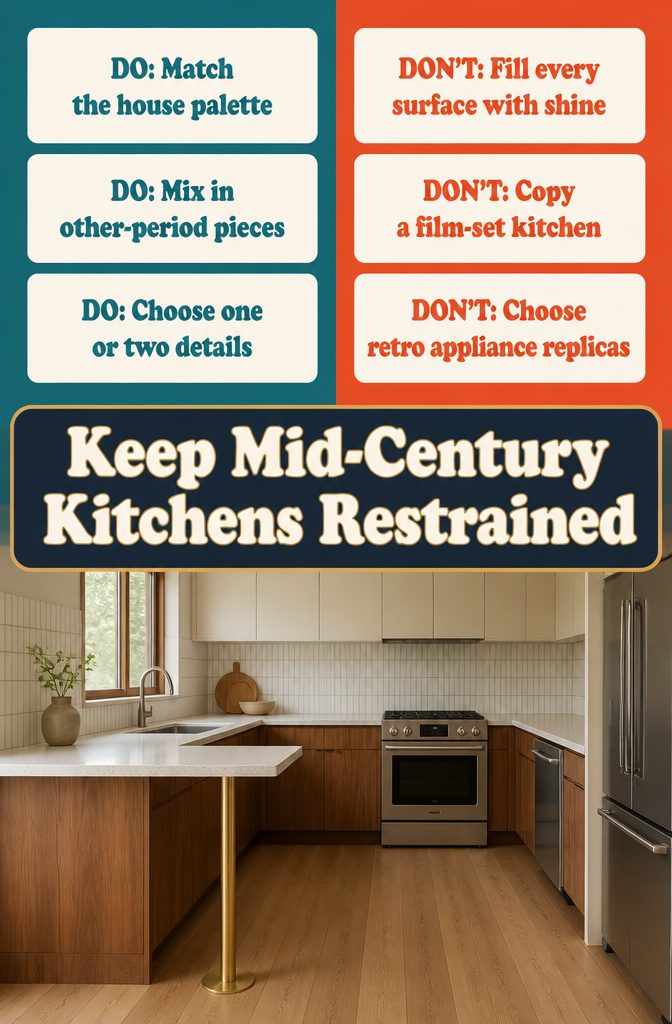
Mid-century style fits best in a home built in the 1950s or 1960s, but it works in other eras too.
Keep the colors and materials close to the rest of the house so the kitchen doesn’t clash with the rooms around it.
Within that limit, mixing in pieces from other periods adds depth and keeps the room from looking like a film set.
Pick one or two period details and let everything else stay plain.
Metallics show how: brass or brushed nickel handles, or a single gold leg under a peninsula, give the room a glimmer, while a kitchen full of shine gets loud.
Modern appliances belong here too. A new range and dishwasher with clean fronts will serve you better than retro replicas.
Frequently Asked Questions
What is a mid century modern kitchen?
It is a kitchen built on the style of the 1950s and 1960s: clean lines, flat-front cabinets, warm natural wood, and geometric or organic shapes.
Period colors and materials such as terrazzo and geometric tile complete the look. Most current versions pair these details with modern appliances.
What colors are typically used in a mid century modern kitchen?
Two palettes are common. Bold versions use orange, teal, chartreuse, avocado green, mustard yellow and citrus shades, while muted versions use buttery yellow, mint green, soft blue, rich browns and clay red.
Walnut cabinets carry the bold colors well, and cream, black or white work for everything else.
How do I make my kitchen look mid century modern?
Start with flat-front cabinets in walnut or another warm wood, then add terrazzo or geometric tile. Choose one focal point, such as a sputnik chandelier or a colored sink, and keep the rest plain.
To save money, new walnut or teak veneer doors on your existing cabinet boxes run about $70–$120 per linear foot, against $200–$350 for full walnut cabinets.
What flooring is best for a mid century modern kitchen?
Natural hardwood is the easiest choice if you already have it.
Refinishing it in a satin or semi-matte finish costs about $3–$5 per square foot, compared with $10–$15 or more for new flooring. Terrazzo, VCT and polished concrete are also period-correct; on a slab house, refinishing the existing concrete is the simplest route.
What is a good backsplash for a mid century modern kitchen?
Geometric tile such as hexagons, diamonds or starbursts is the most recognizable choice.
Elongated subway tile is quieter, and a hand-glazed mosaic or hand-painted ceramics suit a single wall behind the range. Tile runs about $6–$10 per square foot, and a backsplash covers so little wall that a bold pattern stays affordable.