
Costs run from paper templates for a gallery wall to a modular sofa and motorized shades, and the deciding factor is which things your family touches daily.
Spend there, such as button or voice control for the big window facing the sofa, and keep manual cords on small windows nobody adjusts.
1. Flexible Seating That Invites Talk
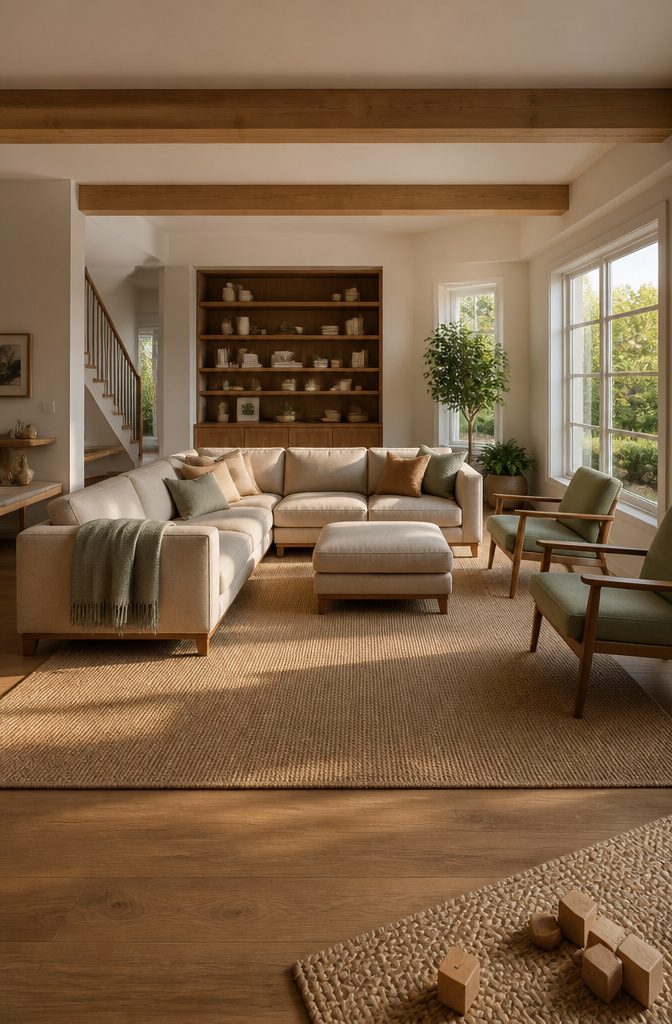
Seating that faces inward gets people talking. Angle a sofa and two chairs toward each other instead of lining everything up at the TV, and leave a clear path through the middle so nobody has to climb over knees.
A modular or sectional sofa is the most flexible option.
Modular pieces can be rearranged into an L, a long run, or separate seats as the day changes. A sleeper sofa or a convertible ottoman adds sleeping space for overnight guests.
Flexible pieces cost more than a fixed set, but they cover more uses, which suits a room that does several jobs.
2. An Area Rug for the Gathering Spot
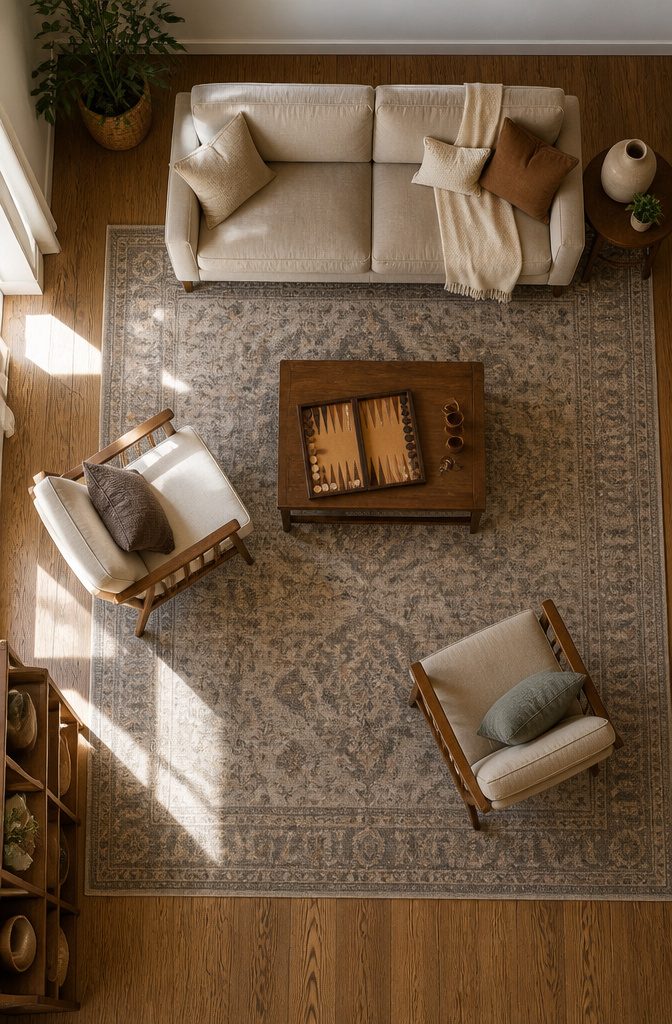
A rug marks where the family gathers. Put it under the main seating and the room gets a center point that people settle around for movies, games, and homework on the floor.
Hard floors, even beautiful wood, feel cold and hard underfoot, and they bounce sound around. A dropped toy can ring through the whole house.
A rug absorbs that noise, cuts the echo, and warms bare feet. Wood stays visible around its edges, so the floor is softened rather than hidden.
Pick a rug that fits the room, not a leftover from a smaller space.
One that looks lost in the middle of the floor defines nothing, and one that crowds the walls makes the room feel tighter. Measure the seating area first and shop to that.
3. Declutter With Closed Storage
In a home you already live in, purge before you buy any storage.
Pull out whatever the family doesn’t use in a normal week, and keep what fits how the room actually gets used. Storage bought first only gives clutter a tidier address.
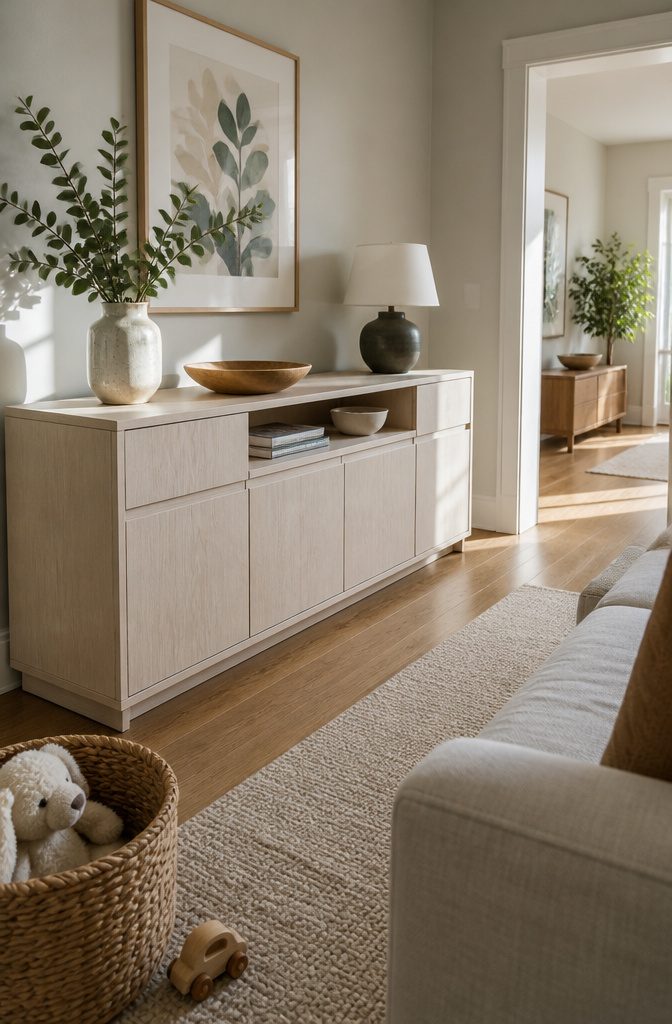
Whatever remains should go behind doors or in drawers where possible. Look at what sits out in plain sight, such as toys, books and media gear, and decide which pieces belong behind doors and which look good on shelves.
That sorting tells you what to buy: built-in bookshelves, end tables with drawers, a credenza or an entertainment center. A whitewashed oak contemporary credenza can hold photo albums, DVD movies and other family memorabilia in a single piece.
4. Set Up an Entertainment Center
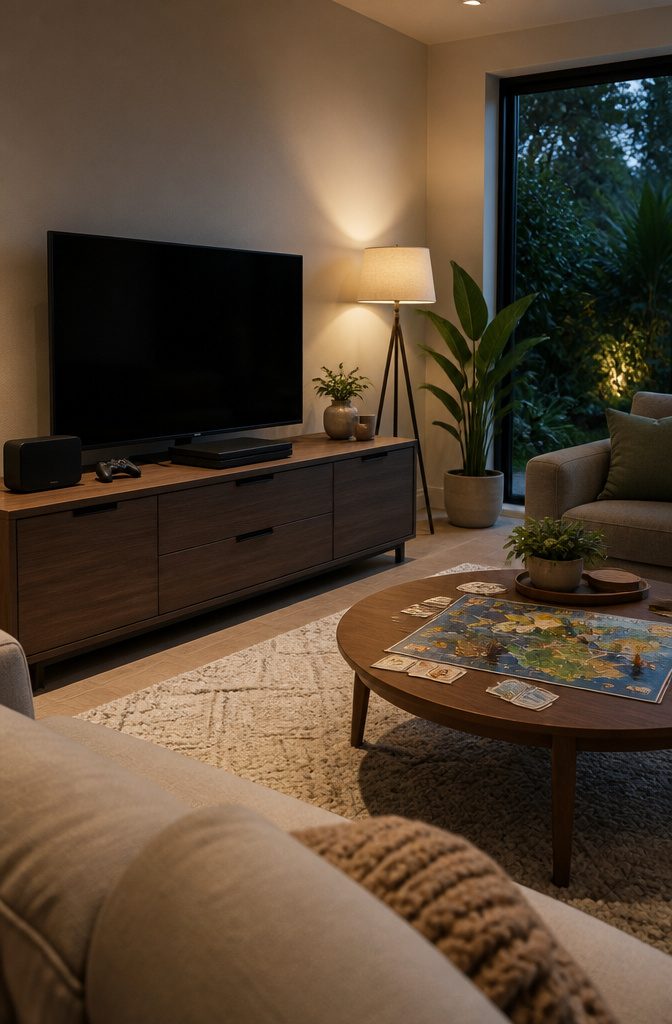
A family room handles TV nights, game sessions, homework and plain time together, so the entertainment center has to hold gear for all of them.
That means a television, an audio system, a gaming console and storage for discs, games and controllers.
A low console under the TV is the better pick for renters, since nothing gets drilled into the wall and it moves with you.
A wall-mounted unit with built-in shelving suits first-home owners who want the floor clear and the shelving to look part of the room.
Either way, pick a piece with drawers or doors for the media and controllers, so the cords and small items stay out of sight.
5. Keep the Coffee Table Usable
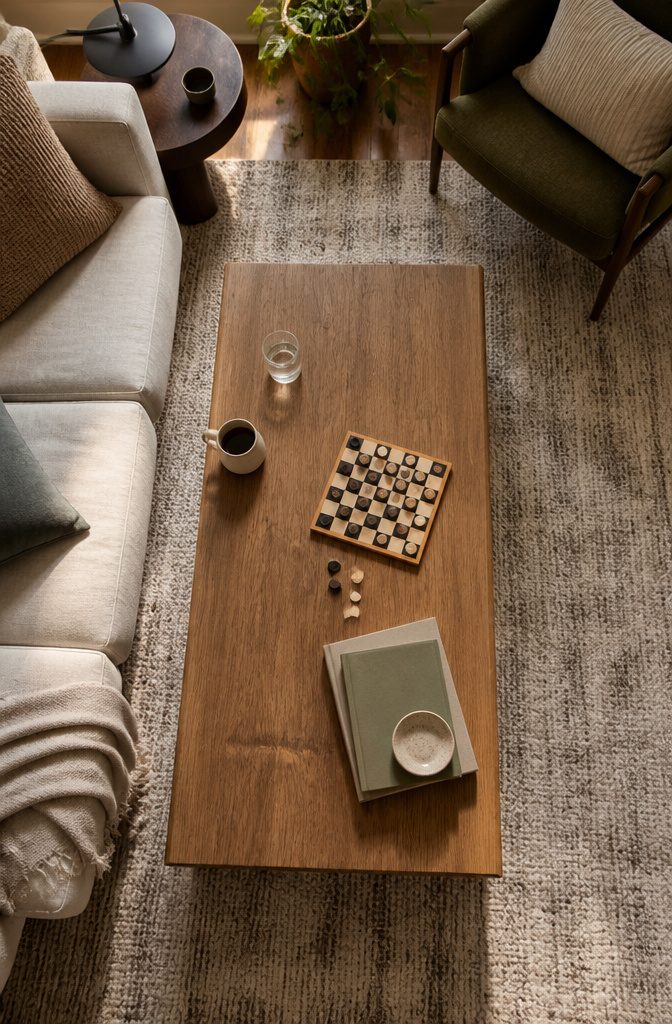
A coffee table crowded with accessories leaves nowhere to set a mug. Keep enough bare surface for a coffee or a glass of wine, and limit decor to one small grouping instead of a scatter of trinkets.
If anyone in the house reads or likes flipping through art books, a short stack of them is the best decoration.
It looks intentional and gets used. Skip it if the stack takes up half the tabletop.
In a family room, the table is also where snacks, drinks and board games land. A clear surface handles game night without anyone clearing a pile of objects first.
6. Add Reading Lights
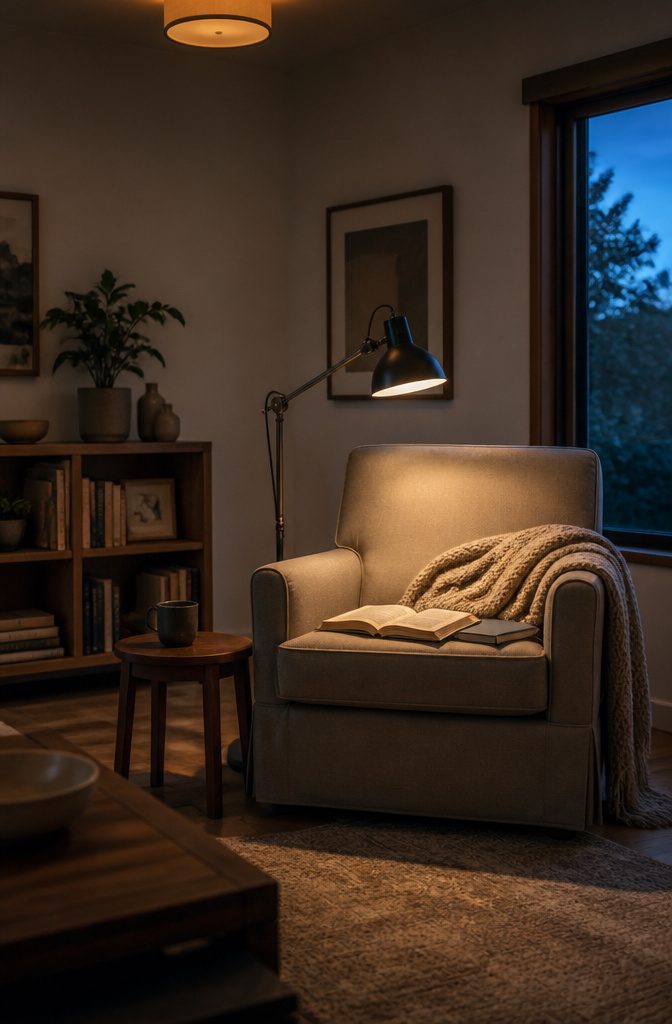
A reading chair needs light that lands on the page, and a floor lamp does that job best.
A floor lamp with an adjustable arm, set behind one shoulder, puts the beam on the book without glare or a shadow from your hand. Pick a warm bulb so the corner feels cozy at night.
A table lamp works if a side table already sits beside the chair. Check that the shade’s lower edge sits near eye level when you’re seated, or the light will spill past the page.
Overhead fixtures supply the ambient layer, the general glow that makes the room usable, and a dimmer softens them after dark. Accent lights, like a small lamp on a shelf, add depth but do little for reading.
7. Layered Window Treatments
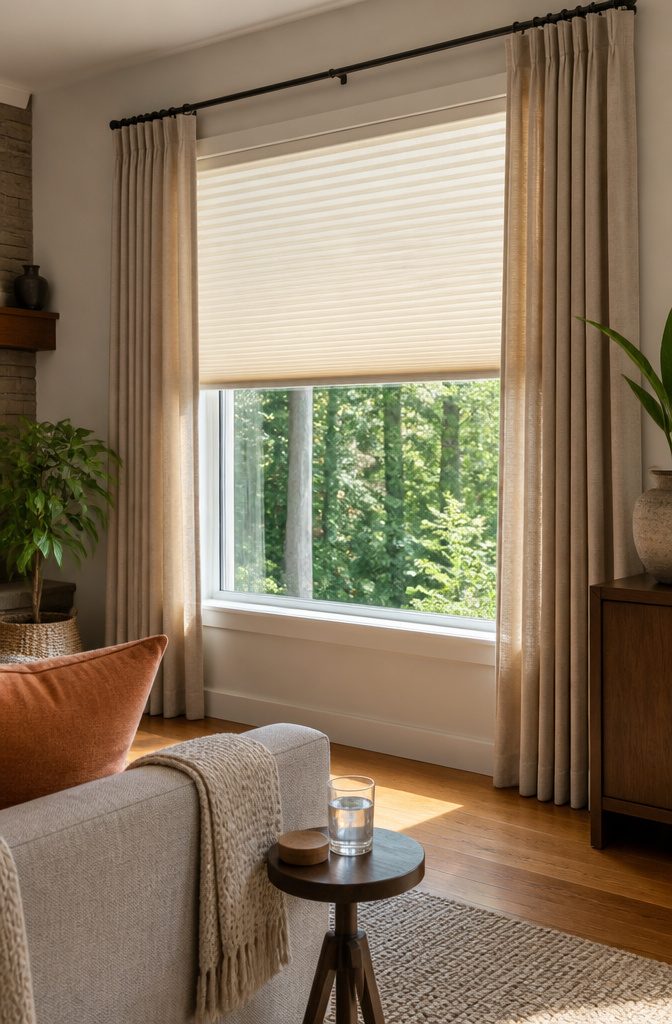
Layer two things at each window: a shade for sun and privacy control, and drapery panels for the look. The panels can hang open as pure decoration, or close for extra privacy when you want it.
Hunter Douglas pleated Solera Soft Shades in the Riley Rivera color work well as the shade layer.
Each window gets its own light and privacy setting, and the shades raise and lower at the click of a button. They can also be raised or dropped by voice command through Alexa or Google.
Motorized shades cost more than manual cord versions.
Spend on button or voice control for the windows you adjust daily, like the big one facing the sofa. Keep cords on small or rarely touched windows.
8. A Relaxing Color Scheme
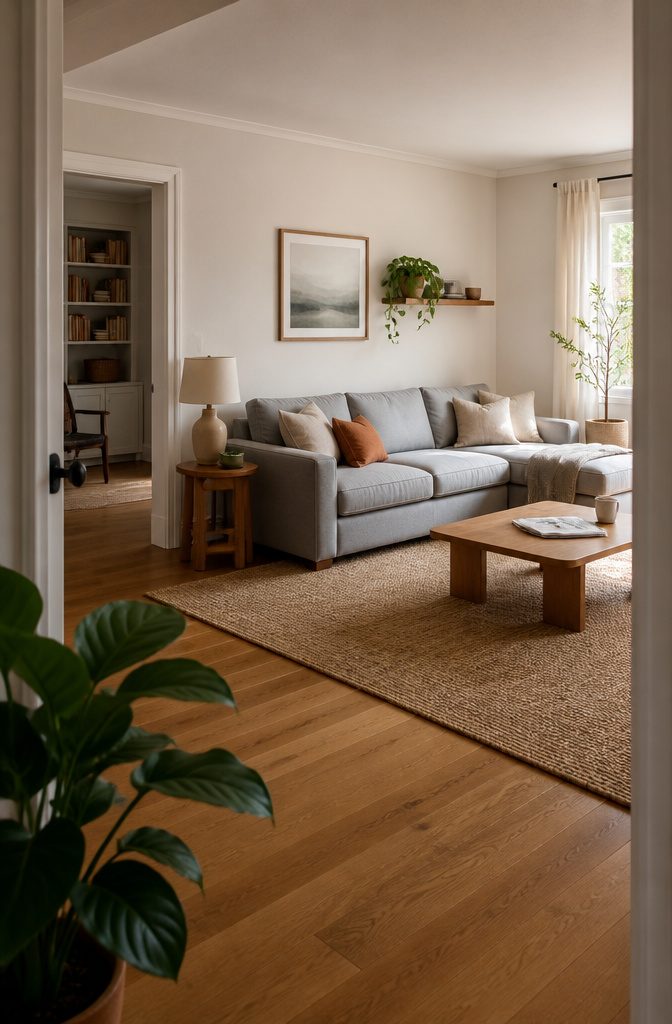
Beige, soft gray and warm white make the most forgiving base for a family room. Keep the walls and the big pieces, like the sofa, in those quiet tones and let pillows, art and plants carry the color.
A bold pillow cover or a pothos on the shelf changes the mood of the room in an afternoon. Swapping it out later costs far less than repainting or replacing a sofa.
Choose one neutral to lead and use the others in smaller amounts. Warm white walls with a soft gray sofa and a few beige accents read as calm, while three neutrals in equal parts can look undecided.
9. Throws and Pillows
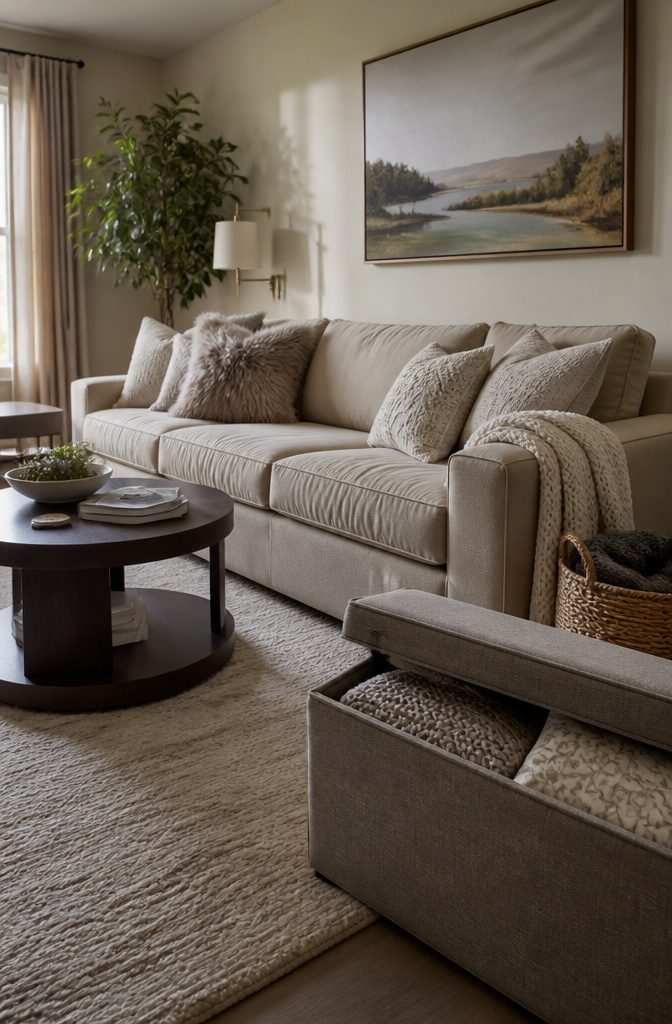
Chenille, faux fur and knit are the fabrics to look for. All three feel soft under your hand, and a few of them make a plain sofa look finished.
Coordinate them with the room’s palette and style so they read as part of the decor. Pillows and blankets dragged in from the bedrooms rarely match, and they stand out against everything else.
Keep the extras in a storage ottoman or a few baskets so the sofa stays clear.
An ottoman holds new throws, blankets and pillows that look like they belong in the room, even on days they end up out of place.
Baskets work the same way, hiding spare blankets and pillows beside the sofa or on a shelf.
10. Layer Different Textures
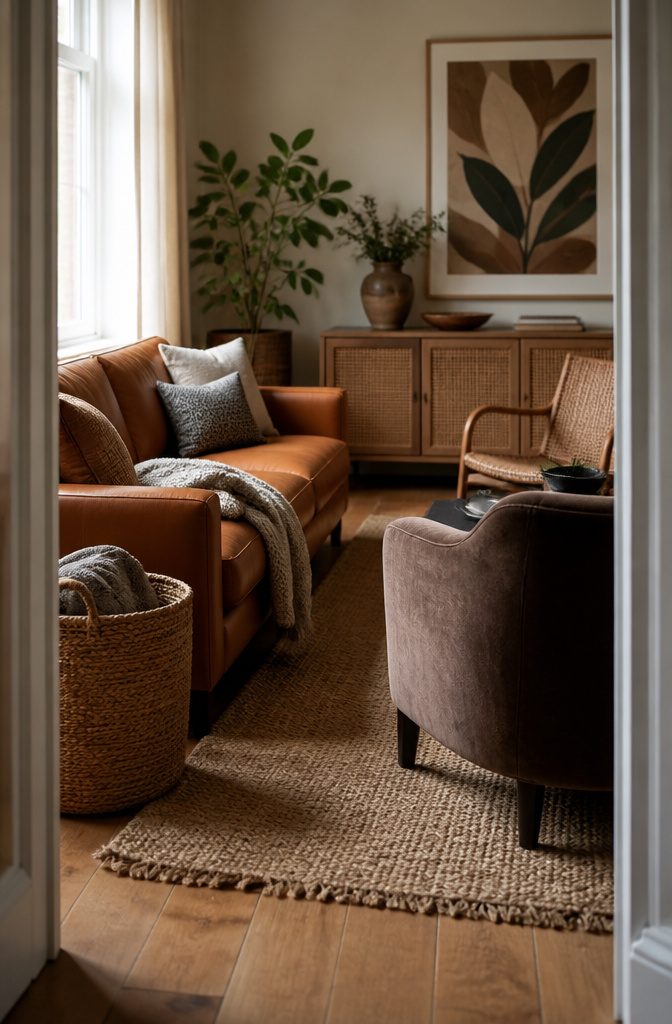
Pick one smooth, one soft and one coarse surface, and give each to a different piece. A leather sofa or armchair gives the room a smooth anchor.
Velvet on an accent chair or ottoman adds a soft surface that catches light differently. Woven pieces, such as a rattan chair, jute basket or cane-front cabinet, add a dry, matte grain that keeps the other two from feeling heavy.
To keep the mix from looking busy, hold the color range narrow and let texture do the contrasting. A few tones from the same family read as layered, while many colors plus many textures read as clutter.
Repeat each material in more than one spot, like a woven basket by the sofa and a woven lamp base across the room.
Leather wipes clean, so it suits the seat that gets the most use. Save velvet for accents.
11. Oversized Art for Scale
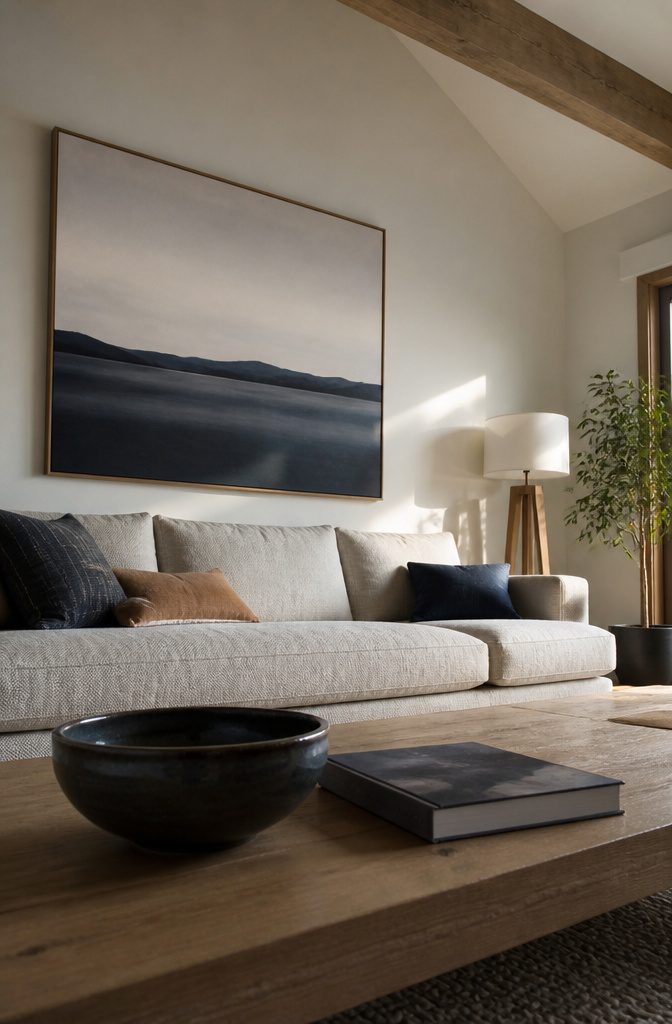
Small, underscaled art makes a wall feel short. Choose a piece that fits the wall without hanging past its edges, or group several smaller pieces so they read as one large mass.
A lone small frame floating over a sofa is the most common way to shrink a room.
Subject matters as much as size. Trompe-l’œil is art of objects that look as if they are really there, so it reads as three-dimensional.
That sense of depth makes a family room feel larger than it is. A soft, almost navy landscape in a neutral contemporary style, printed as a giclee, gives the wall distance without competing with everything else in a busy room.
12. A Family Gallery Wall
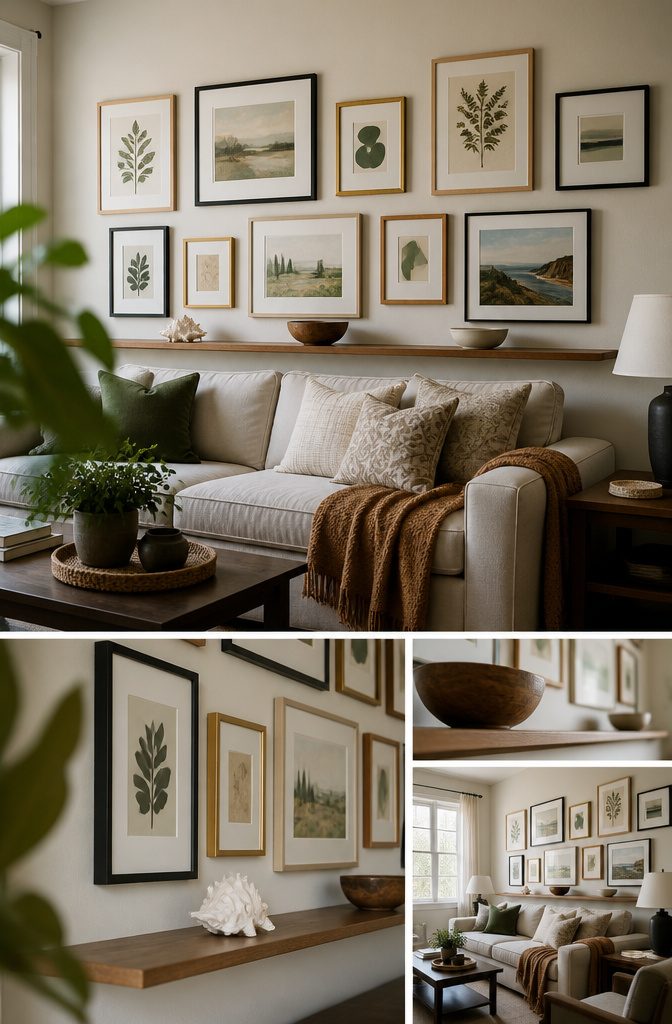
Mix frame finishes and sizes on purpose: wood, black, white and metal all work together if one thing repeats, like the mat color or the spacing.
Hang family photos next to kids’ drawings, a framed postcard or a ticket from a trip, so the wall reads as your family and not a row of portraits.
Before you touch a hammer, trace each frame on paper and tape the shapes to the wall.
Shuffle them until the gaps look even, then nail through the paper. In a rental, this saves you from patching extra holes.
Add a shelf nearby for souvenirs: a shell, a market bowl, a small dish of ticket stubs. Group a few pieces and leave empty space around them so each one gets noticed.
13. Nature-Inspired Decor
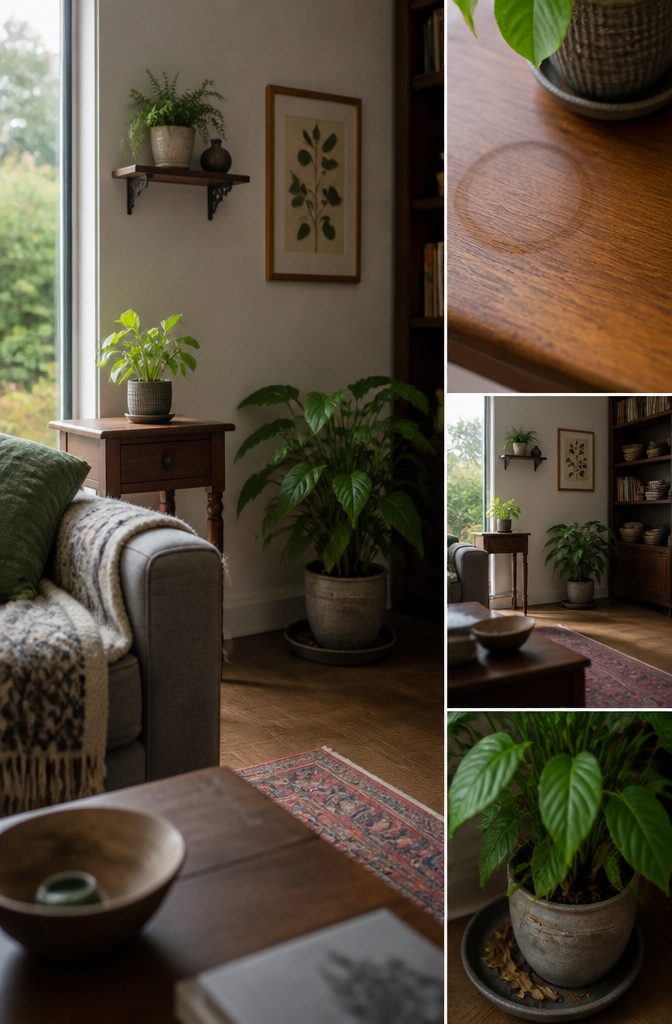
Houseplants are the easiest nature-inspired idea for a small budget and a weekend. A few pots can go in on a Saturday afternoon, and they cost far less than furniture or art.
Set them at different heights, such as a shelf, a side table and the floor, so the room feels layered. Choose forgiving plants that tolerate dim corners, and check the label for pet and child safety before you buy.
Natural wood furniture brings the most warmth to a family room and costs the most.
A secondhand solid wood side table or bench, cleaned and oiled, gives you the look in an afternoon. Botanical prints come next in price, and they work best after the plants and wood have set the mood.
14. A Kid-Friendly Area
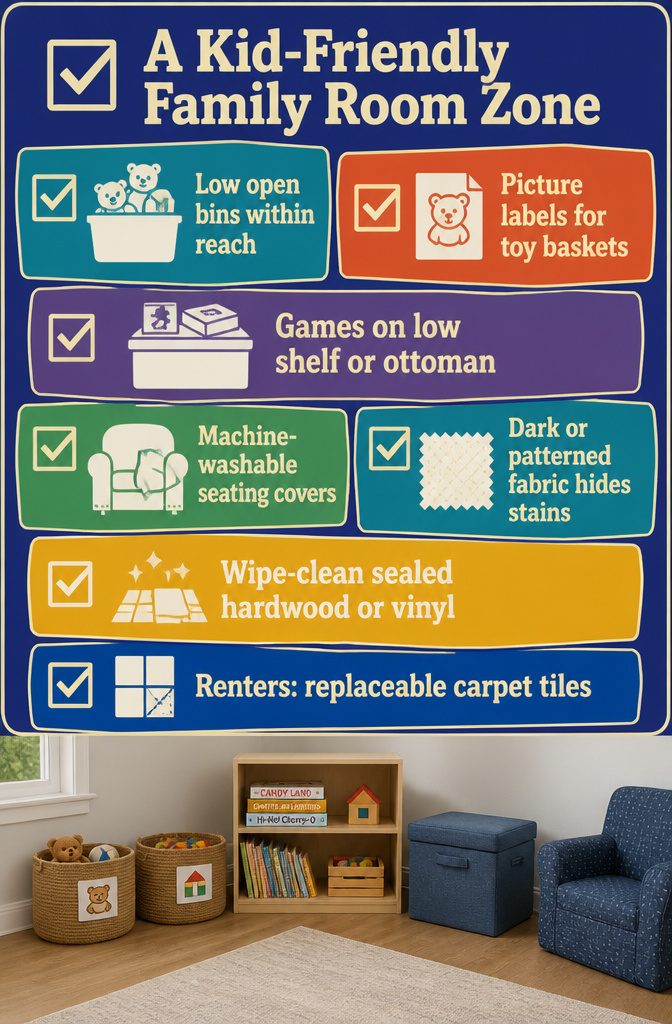
Pick one corner or wall for the kids and keep everything they use within their reach.
- Low, open bins and baskets let a child drop toys in without help. Picture labels work for kids who can’t read yet.
- Store board games and puzzles on a lower shelf or inside a lidded ottoman, so cleanup is one motion.
- Cover the seating in this zone with slipcovers or performance fabric that you can machine wash. Darker or patterned weaves hide stains between washes.
- For the floor, choose something you can wipe: sealed hardwood, vinyl plank, or laminate. If you rent and can’t change the floor, carpet tiles let you pull up and replace a single stained square.
Family Room vs. Living Room
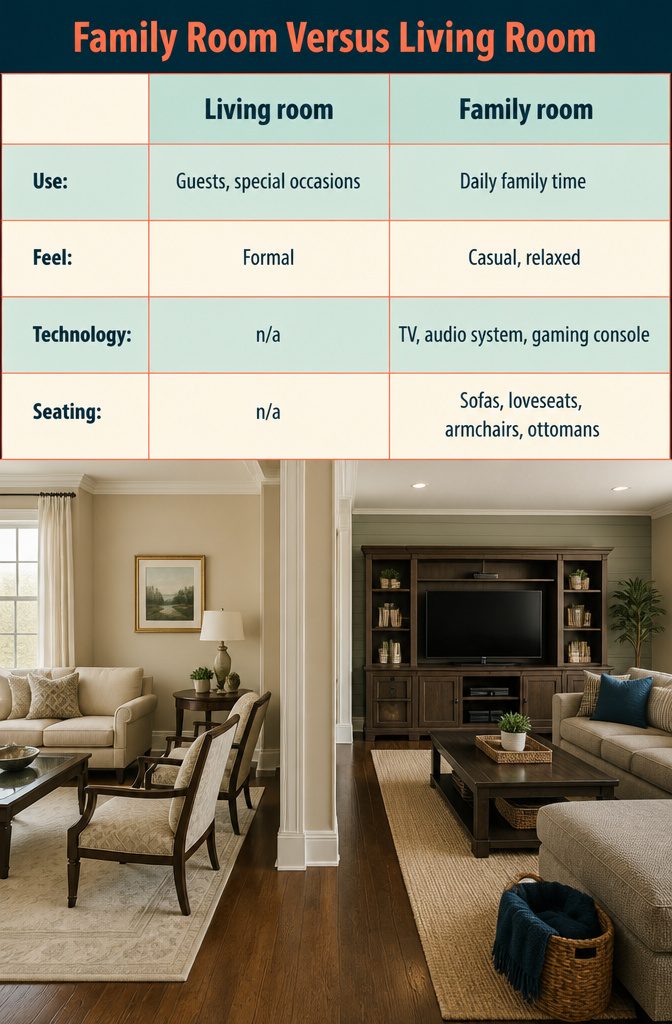
The living room is usually the formal space for hosting guests and special occasions. The family room is the casual one, built for daily gatherings and leisure, so it gets the pieces that take daily wear.
| Living room | Family room | |
|---|---|---|
| Use | Guests, special occasions | Daily family time |
| Feel | Formal | Casual, relaxed |
| Technology | n/a | TV, audio system, gaming console |
| Seating | n/a | Sofas, loveseats, armchairs, ottomans |
A working family room needs seating in soft, durable upholstery, an entertainment center, a coffee table, storage, ambient, task and accent lighting, versatile furniture such as a sleeper sofa, and a few personal touches.
Frequently Asked Questions
What is a family room and what should be in it?
A family room is a casual space where a family spends everyday time together, from TV nights to homework and games.
It needs soft, durable seating, an entertainment center, a coffee table, storage, and ambient, task and accent lighting. Add versatile furniture such as a sleeper sofa, plus personal touches like family photos and art.
What is the difference between a living room and a family room?
A living room is usually the formal space for hosting guests and special occasions.
A family room is the relaxed one used for daily gatherings and leisure. Because it sees daily wear, the family room gets the TV, audio system, gaming console and seating built to last.