
Engineered stone made of 90–95% ground quartz bound with resin, this counter material costs $50–$200 per square foot installed.
Resin share sets the price: First Choice slabs at 7–8% resin run $80 to over $100. Quartz resists heat only briefly, and burn marks can’t be repaired.
What Quartz Countertops Are
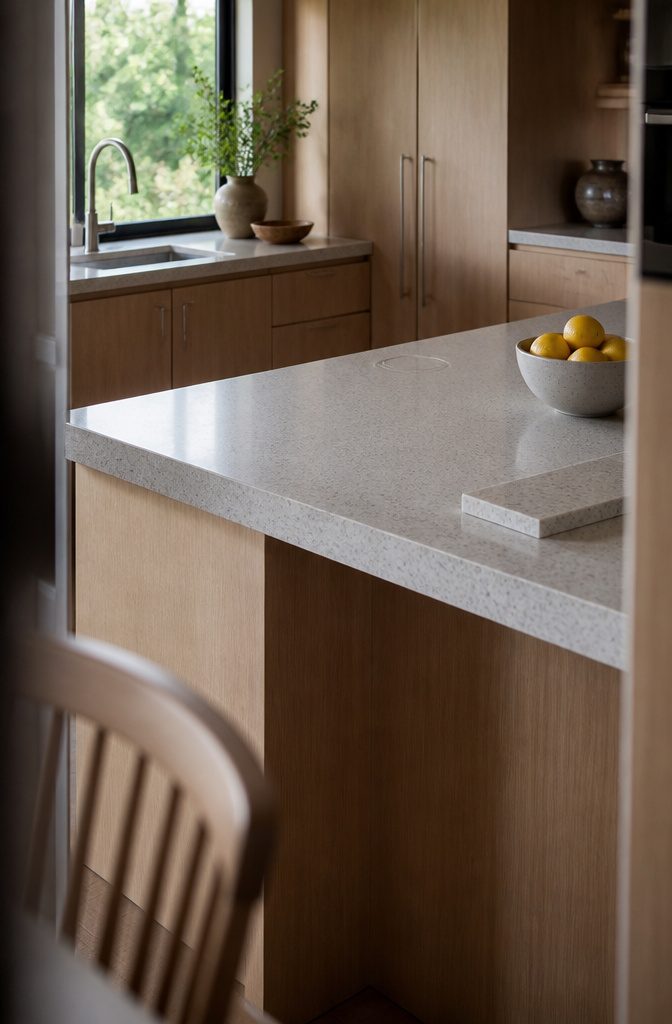
Quartz countertops are engineered stone, not slabs of pure quartz. Manufacturers grind natural quartz and bind it with resins, polymers, and pigments, usually about 90–95% stone to 5–10% binder.
Quality grade changes that ratio: First Choice slabs run 7–8% resin. Caesarstone, Silestone, and Cambria are the premium brands, and they generally cost more than lesser-known makers because their color is more consistent and their patterns more distinctive.
A slab measures about 120 by 55 inches. Standard thicknesses are 12mm, 20mm, and 30mm, and the last two are also listed as 2cm (¾ inch) and 3cm (1¼ inch).
3cm costs more but is stronger and looks more substantial, so it is the better pick if your budget stretches that far.
Recommended Products

No Unnecessary Ingredients: HOPE'S Perfect Quartz is free of sunscreen, silicone, and oil to create a unique residue-free formula that leaves your quartz countertops perfectly clean and spotless

NEW DISINFECTING FORMULA: Kills 99.9% of germs & bacteria, Kills the following bacteria in 10 minutes on hard, non-porous surfaces

EVERY DAY CLEANING: To preserve and protect your natural stone sink, countertop, floor, tile, and other surfaces; it removes grime, dirt, and debris leaving a streak-free finish
Why Quartz Suits Kitchens
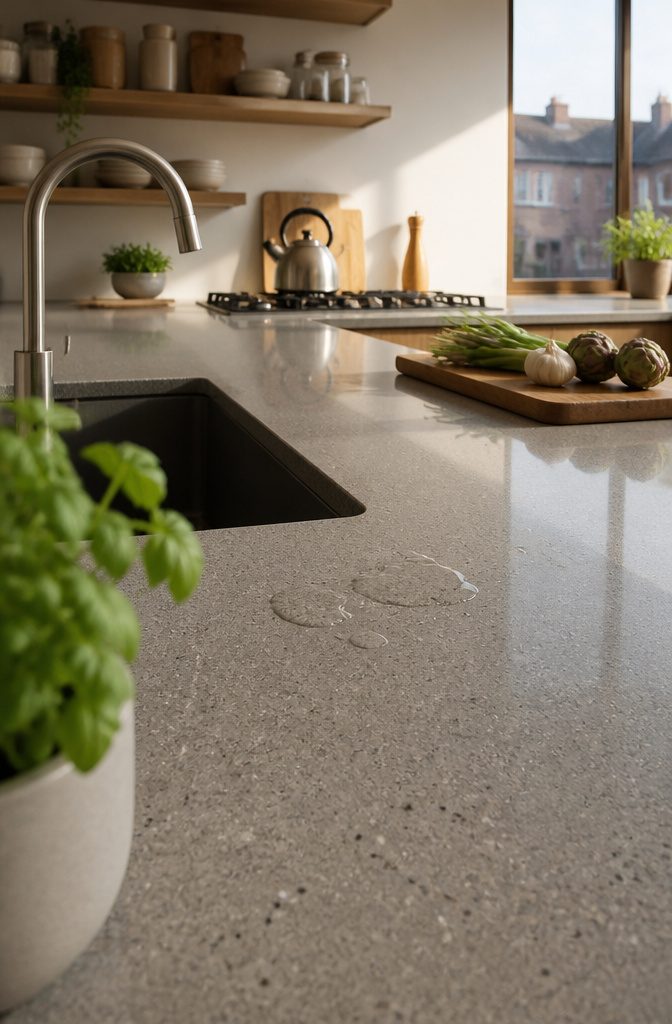
Caesarstone makes the durability case plainly:
Of all countertop materials in the market, quartz is the most durable. It is one of the hardest materials, with a rating of 7 on the Mohs hardness scale.
That rating of 7 is why quartz resists scratches through years of daily cooking.
The surface is also non-porous.
Spills resist staining, bacteria don’t build up, and quartz never needs sealing, which saves you the upkeep natural stone demands. With proper care it lasts 20+ years.
A counter you replace less often also has a lower environmental impact. Quartz comes in a wide range of looks, covered in its own section below.
Recommended Products

🥘【PREMIUM SAFE MATERIAL】- Our hot pads for countertops are made from 100% food-grade silicone, exposure to food safety. Non-slip, flexible enough to comfortably grab a hot dish or pan. These trivets for hot pots and pans also can as dish drying mat helps dry items when you need to dry.

HIGH-QUALITY SILICONE TRIVET MAT: The Trivets are made of food grade, BPA-Free, and heat-resistant silicone material that is absolutely safe for your health. The flexible & durable hot pad won't rust, crack or chip.

PREMIUM FOOD-GRADE SILICONE & PERFECT SIZE - Made from 100% <br>BPA-free food grade silicone and can pass FDA test, non-slip,flexible <br>enough to comfortably grab a hot dish, measures 9x12x0.24 <br>inches(thicker than competitors).
Quartz Costs $50–$200 per Square Foot
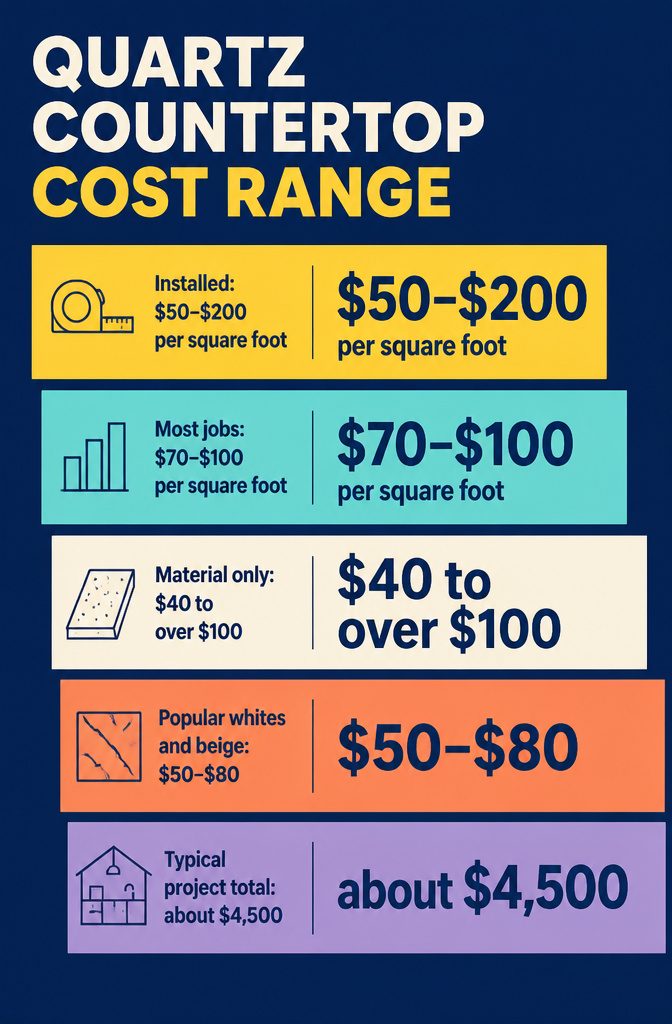
Quartz runs $50–$200 per square foot installed, and most jobs land at $70–$100.
The material alone is $40 to over $100. Most homeowners spend about $4,500 total, within quotes of $1,500–$8,000 or, at the extremes, $1,000–$12,000.
Popular whites with gray veining and warm beige run $50–$80. Tiers against other surfaces:
| Option | Price per sq ft |
|---|---|
| First Choice quartz (7–8% resin) | $80 to over $100 |
| Commercial Grade quartz (8–11% resin) | $60–$80 |
| Second Choice quartz (over 12% resin) | $50–$60 |
| Granite | $50–$100 |
| Marble | $60–$120 |
| Laminate | $10–$40 |
| Other natural stone | $40–$200 |
Recommended Products

✅ FOOD PREP SAFE, NON-TOXIC: Traditional epoxy repair kits release harsh chemical fumes and leave you uncertain about surface safety around food. Our UV-cure formula is non-toxic, virtually odorless, and certified safe for food preparation surfaces once cured.

30-SEC UV QUICK CURE, LONG-LASTING FINISH: Cures quickly under 395nm UV light in roughly 30 seconds. Waterproof, scratch-resistant and non-yellowing bond holds steady for daily kitchen and bathroom use.

HIGH PERFORMANCE GRANITE POLISHING PADS: The granite diamond polishing pads are made of premium diamond and resin. Fast grinding force, good flexibility, wear-resistance, high polishing efficiency and long service life
Quartz Colors and Patterns
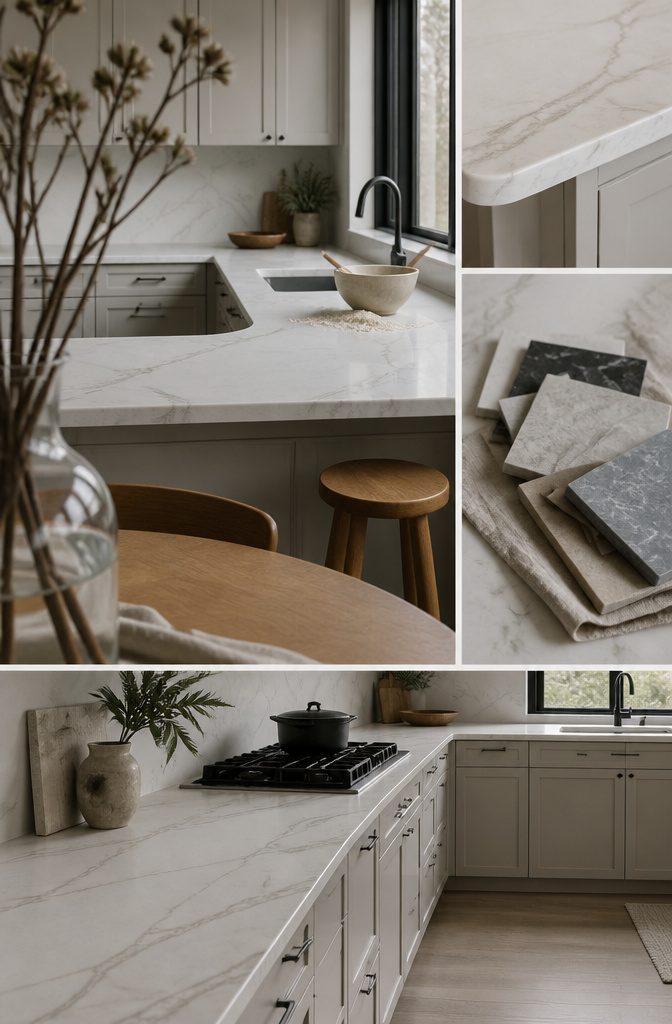
Quartz comes in white, gray, black, brown, beige, and even blue.
For gray, Caesarstone offers 4044 Airy Concrete, 6313 Turbine Grey, and 5000 London Grey. For color beyond neutrals, look at 515 Palm Shade, 406 Clearskies, and 405 Midday.
Pattern matters as much as color. Solid suits minimalist kitchens.
Veined quartz, like Calacatta and Carrara looks, copies marble for a classic room. Speckled or flecked adds texture, swirled reads as artistic, and concrete-look fits industrial or modern spaces.
Order samples first.
Caesarstone charges $35 for sample shipping, with standard delivery in 3–5 business days. View them in your kitchen’s own lighting.
Recommended Products

PRECISE SIZE FOR YOUR PROJECT – Measures 37 inches wide and 4 inches high. Please measure your countertop and check the available installation space before ordering to ensure a proper fit.

Transform the look of outdated countertops with a faux marble kit

PRECISE SIZE FOR YOUR PROJECT – Measures 61 inches wide and 4 inches high. Please measure your countertop and check the available installation space before ordering to ensure a proper fit.
How to Choose a Color and Pattern
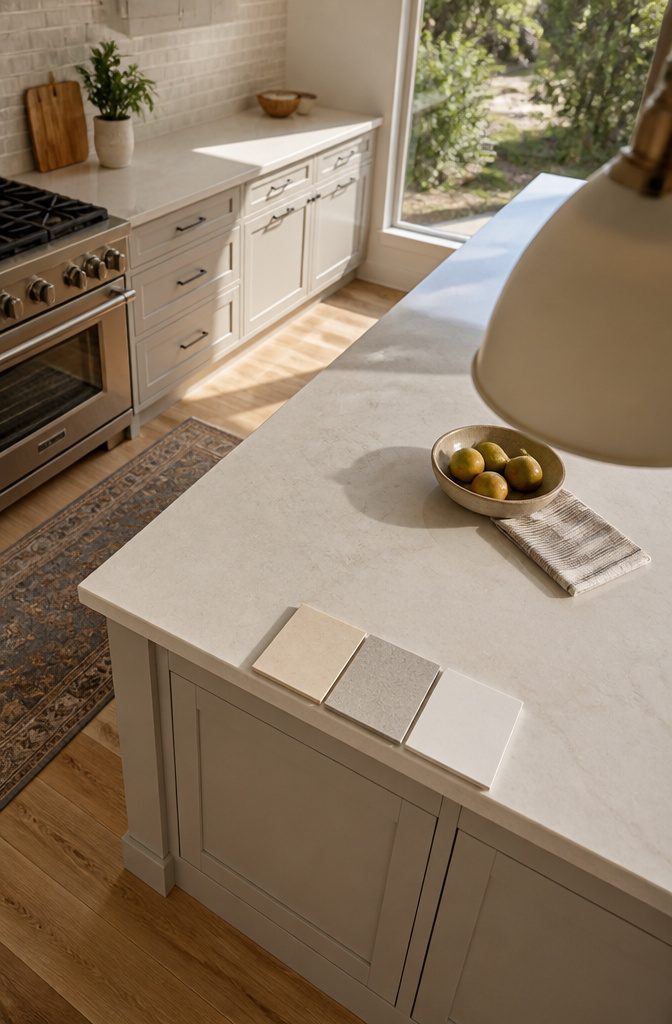
Start with what you are keeping: cabinets, flooring, and backsplash. Match the countertop’s undertone, warm or cool, to those surfaces, and let only one of them carry a busy pattern.
Modern and contemporary kitchens suit solid whites, grays, and slabs with little veining. Traditional kitchens look right with soft veining and creamy tones.
Farmhouse kitchens favor white or light gray with gentle movement. Eclectic kitchens can take bold veining if the cabinets and backsplash stay quiet.
Showroom lighting flatters every slab, so view samples in your own kitchen under its own light.
Check them in morning sun, at night under your bulbs, and next to the cabinet and floor. Popular colors run $50–$80 per square foot, so a safe, well-liked shade also protects your budget.
Recommended Products

Clear Style, Clean Counter: Crystal-clear, 100% food-safe acrylic keeps your counters looking sharp. The MEWSDEN acrylic cutting board with counter lip slides right into any minimalist kitchen—an everyday essential for homes, apartments, and stylish kitchen decor

【𝑬𝑳𝑬𝑽𝑨𝑻𝑬 𝒀𝑶𝑼𝑹 𝑪𝑶𝑶𝑲𝑰𝑵𝑮 𝑬𝑿𝑷𝑬𝑹𝑰𝑬𝑵𝑪𝑬】Our acrylic cutting board incorporates both function and style.Crafted from 100% food-grade acrylic, this board is not only hygienic but also enhances your countertop aesthetics, becoming an absolute essential in your kitchen setup.

Crystal Clear & Invisible Protection: This clear silicone countertop protector mat is ultra-transparent, acting as an invisible shield for your quartz, granite, or marble surfaces. Unlike other protective mats for kitchen counters, it won’t hide the beauty of your countertops, making it the perfect clear countertop mat for any decor
Care and Maintenance
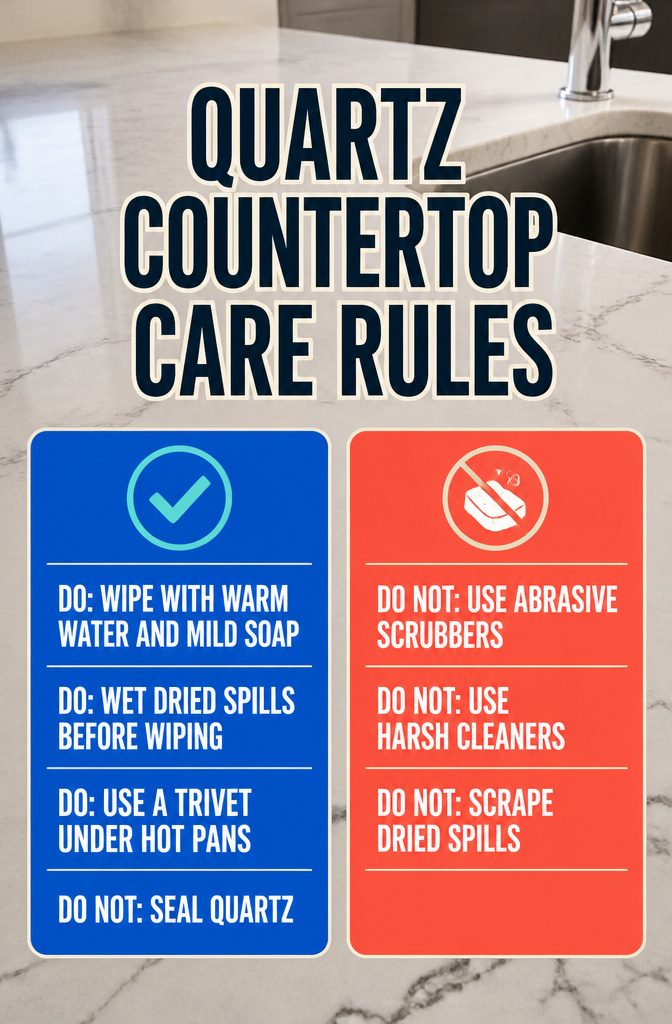
Daily care takes a damp cloth and very little else.
- Wipe with warm water and mild soap. For stubborn spills, use a non-abrasive cleaner.
- For dried spills, wet the spot and let the water sit a few minutes, then wipe with a damp towel. Scraping isn’t needed.
- Skip sealing. Unlike granite, quartz doesn’t need it, which saves you time and money.
- Avoid abrasive scrubbers and harsh cleaners.
- Set a trivet or hot pad under every hot pan and appliance. Quartz resists heat but isn’t heat-proof, and it handles high heat only briefly. Burn marks can’t be repaired.
Recommended Products

FOOD GRADE SILICONE AND NON SLIP: Walfos trivets for hot dishes are made of food grade silicone, BPA-Free, won't absorb odor, stain, rust, crack or chip. Non-slip design of these silicone trivets make nothing slide off

OVERSIZE SILICONE MAT: Our curling iron mat is designed as 14.2 x 11.0 inches, weight 0.43 lb, larger than other hot pad, extra large size can hold multiple hair styling tools at once, no need to use multiple mats

5mm Thick Heat Protection: Crafted from 5mm thickened material, this kitchen counter mat is heat resistant and durable. The heat-proof mat stays flat without curling or wrinkling, delivering reliable countertop heat insulation. Ideal for use under electric grills, air fryers, stock pots, slow cookers and ovens
Edges, Cutouts, and Add-On Costs
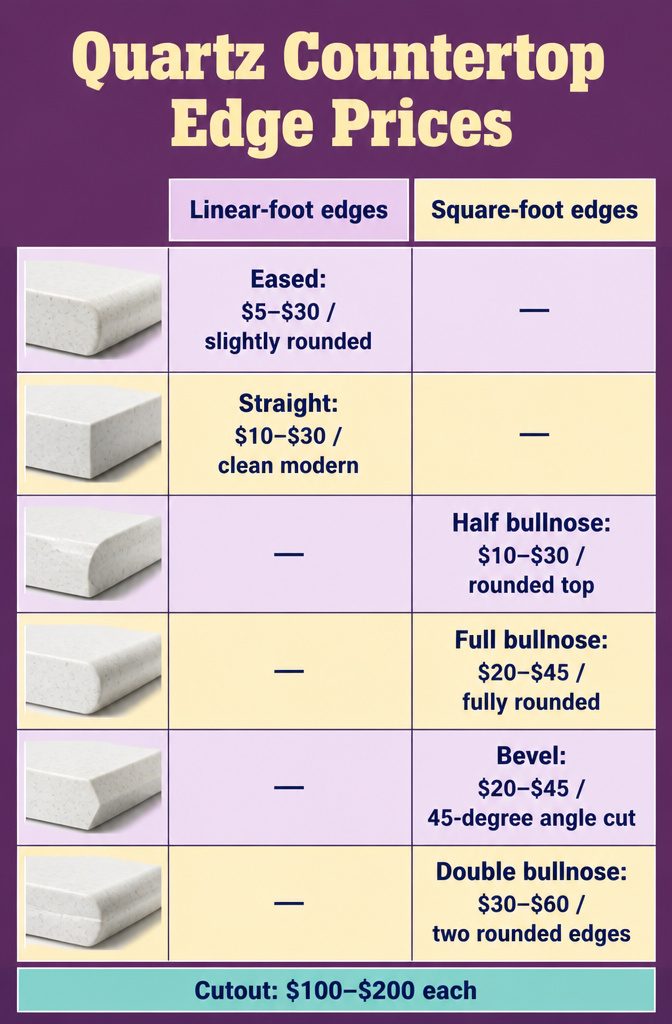
Eased and straight edges are priced per linear foot, while the rest are priced per square foot, so compare quotes carefully.
| Edge | Price | Look |
|---|---|---|
| Eased | $5–$30 per foot | Slightly rounded |
| Straight | $10–$30 per foot | Clean, modern |
| Half bullnose | $10–$30 per sq ft | Rounded top edge |
| Full bullnose | $20–$45 per sq ft | Completely rounded |
| Bevel | $20–$45 per sq ft | 45-degree angle cut |
| Double bullnose | $30–$60 per sq ft | Two rounded edges |
Each cutout for a sink or cooktop adds $100–$200.
Using 2cm slabs in less-used areas can save 15–20% on material. Ask for written quotes that list edges, cutouts, and seams separately, and find out where the seams will fall.
Recommended Products

PROFESSIONAL-GRADE SEALER: For use on natural and engineered countertop stone surfaces including granite, quartz, marble and more

Luxurious Aesthetic: Emulates the high-end look of white quartz with a glassy sheen, ideal for adding a touch of elegance to both traditional and contemporary spaces.

No Unnecessary Ingredients: HOPE'S Perfect Quartz is free of sunscreen, silicone, and oil to create a unique residue-free formula that leaves your quartz countertops perfectly clean and spotless
Installation and Timeline
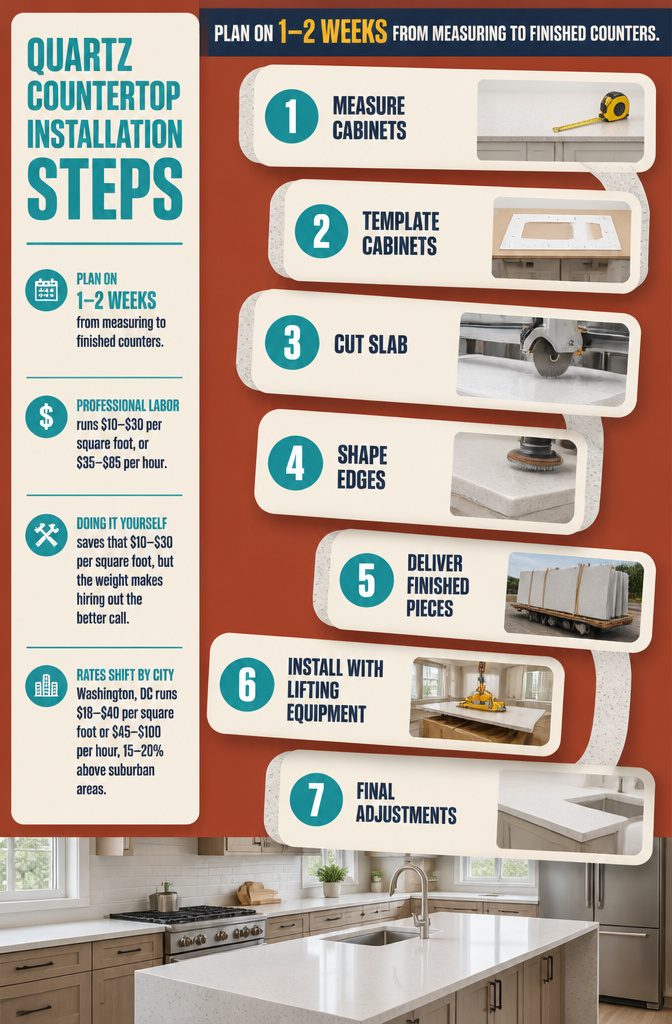
- Measure. Check the cabinet run and ask whether removing your old counters is in the installer’s price.
- Template. The fabricator makes a template of your cabinets.
- Fabrication. The slab is cut to that template.
- Edge finishing. The edges are shaped in the shop.
- Transport. The finished pieces are delivered to your home.
- Installation. Slabs weigh 20–25 pounds per square foot, so this takes a crew and lifting equipment.
- Final adjustments. The crew checks the fit and corrects any issues.
Plan on 1–2 weeks from measuring to finished counters.
Professional labor runs $10–$30 per square foot, or $35–$85 per hour.
Doing it yourself saves that $10–$30 per square foot, but the weight makes hiring out the better call. Rates shift by city: Washington, DC runs $18–$40 per square foot or $45–$100 per hour, 15–20% above suburban areas.
Recommended Products

PRECISE SIZE FOR YOUR PROJECT – Measures 31 inches wide and 4 inches high. Please measure your countertop and check the available installation space before ordering to ensure a proper fit.

PRECISE SIZE FOR YOUR PROJECT – Measures 18 inches wide and 4 inches high. Please measure your countertop and check the available installation space before ordering to ensure a proper fit.
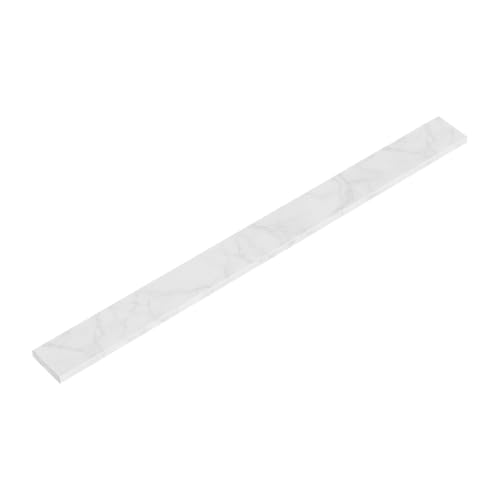
PRECISE SIZE FOR YOUR PROJECT – Measures 48 inches wide and 4 inches high. Please measure your countertop and check the available installation space before ordering to ensure a proper fit.
Warranty and Outdoor Use
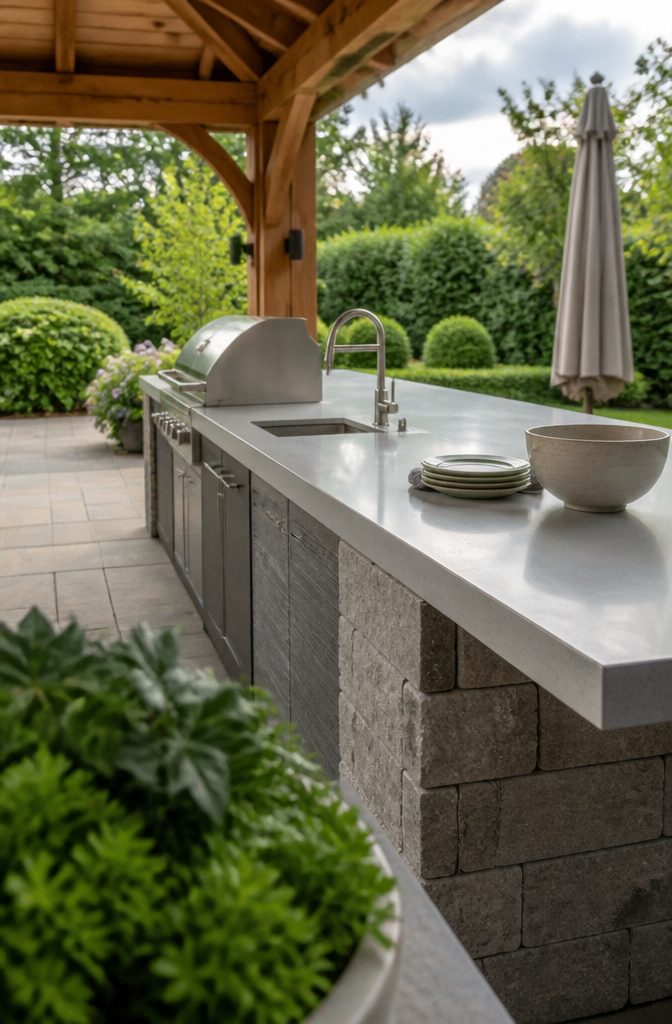
Caesarstone backs its indoor countertops with a lifetime warranty. Its outdoor selection carries a 10-year warranty instead.
Outdoor quartz comes from a separate collection, so if you want quartz for a patio kitchen or outdoor bar, ask for that collection by name rather than assuming an indoor color can go outside.
Warranty terms differ by brand, and one company’s lifetime coverage won’t necessarily match another’s. Read the written terms before you pay a deposit, and look for what they say about indoor versus outdoor installation.
Recommended Products

BEST GRANITE CLEANER AND POLISH: Includes (2) 16 oz. bottles of Therapy Granite Cleaner and Polish, a top choice for maintaining pristine surfaces.

EVERY DAY CLEANING: To preserve and protect your natural stone sink, countertop, floor, tile, and other surfaces; it removes grime, dirt, and debris leaving a streak-free finish

60/40 DOUBLE BOWL DESIGN: Larger main bowl handles pots and pans while the smaller bowl is ideal for prep and rinsing, making multitasking easier
Frequently Asked Questions
Recommended Products

HEAT RESISTANT PROTECTION: Our trivets for hot pots and pans are designed to withstand temperatures up to 446°F, providing a safe and reliable surface to rest your hot pots, pans, and baking dishes. Avoid damaging your countertops or tables with our premium and durable silicone pot holders. They also serve as hot pads for kitchen countertops, giving you extra protection from scorching heat

Heat Resistant & Fireproof: Our mat is made of fiberglass with silicone coating on both sides, which can provide heat resistance up to 1022℉
How much do quartz kitchen countertops cost?
Quartz runs $50–$200 per square foot installed, and most jobs land at $70–$100.
Most homeowners spend about $4,500 total. Price depends on resin content and brand: First Choice slabs cost $80 to over $100 per square foot, and Second Choice slabs cost $50–$60.
How long do quartz kitchen countertops last?
With proper care, quartz lasts 20 years or more.
It rates 7 on the Mohs hardness scale, so it holds up to scratches from daily cooking. Its non-porous surface also resists stains.
Do quartz countertops need to be sealed?
No.
Quartz is non-porous, so it doesn’t absorb spills the way granite does. That removes the sealing step and its cost from your upkeep.
Can you set a hot pan on a quartz countertop?
Use a trivet or hot pad every time.
Quartz resists heat but is not heat-proof, and it tolerates high heat only briefly. Burn marks can’t be repaired.
How do you clean quartz countertops?
Wipe with a damp cloth, warm water, and mild soap. For stubborn spills, use a non-abrasive cleaner.
For dried spills, wet the spot, let the water sit a few minutes, and wipe it up without scraping. Abrasive scrubbers and harsh cleaners can harm the surface, so avoid them.
What colors do quartz countertops come in?
Quartz comes in white, gray, black, brown, beige, and blue.
Patterns range from solid to veined (Calacatta and Carrara looks), speckled, swirled, and concrete-look. Order samples and view them in your own kitchen lighting before you choose.
Should I choose 2cm or 3cm quartz?
Choose 3cm if your budget allows, because it is stronger and looks more substantial.
It costs more than 2cm (about ¾ inch), which is the cheaper option. Using 2cm slabs in less-used areas can cut material costs by 15–20%.
How long does it take to install quartz countertops?
Plan on 1–2 weeks from measuring to finished counters.
In that time the fabricator templates your cabinets, cuts the slab, finishes the edges in the shop, and delivers the pieces. A crew then installs them.
Can I install quartz countertops myself?
You can, but hiring out is the better call.
Slabs weigh 20–25 pounds per square foot, which takes a crew and lifting equipment. Professional labor costs $10–$30 per square foot, and that is all a DIY job would save.
Can quartz countertops be used outdoors?
Only if you buy quartz from the manufacturer’s outdoor collection.
Caesarstone’s outdoor selection carries a 10-year warranty, while its indoor countertops carry a lifetime warranty. Ask for the outdoor collection by name rather than assuming an indoor color is safe outside.